Compare
Enviro-Rock vs foam board (Styrofoam) under slabs
Under a slab, Enviro-Rock replaces the rigid polystyrene foam board (EPS or XPS, often called Styrofoam) and the drain rock below it with one layer that drains, insulates and gives soil gas a path to the radon pipe.[1][2] Foam board insulates more per inch: in road trials, foam glass aggregate layers were three to five times thicker than XPS for similar frost protection.[3][4]
Enviro-Rock at a glance
- Loose dry bulk density
- 200 kg/m³
- Angle of friction
- 39° at 65 kPa
- Thermal resistance
- R-2.4 per inch, dry
- Up to, per B-train load
- 140 m³
From the Enviro-Rock specification table and delivery trailer sheet.
How it goes in
Under a slab: two builds
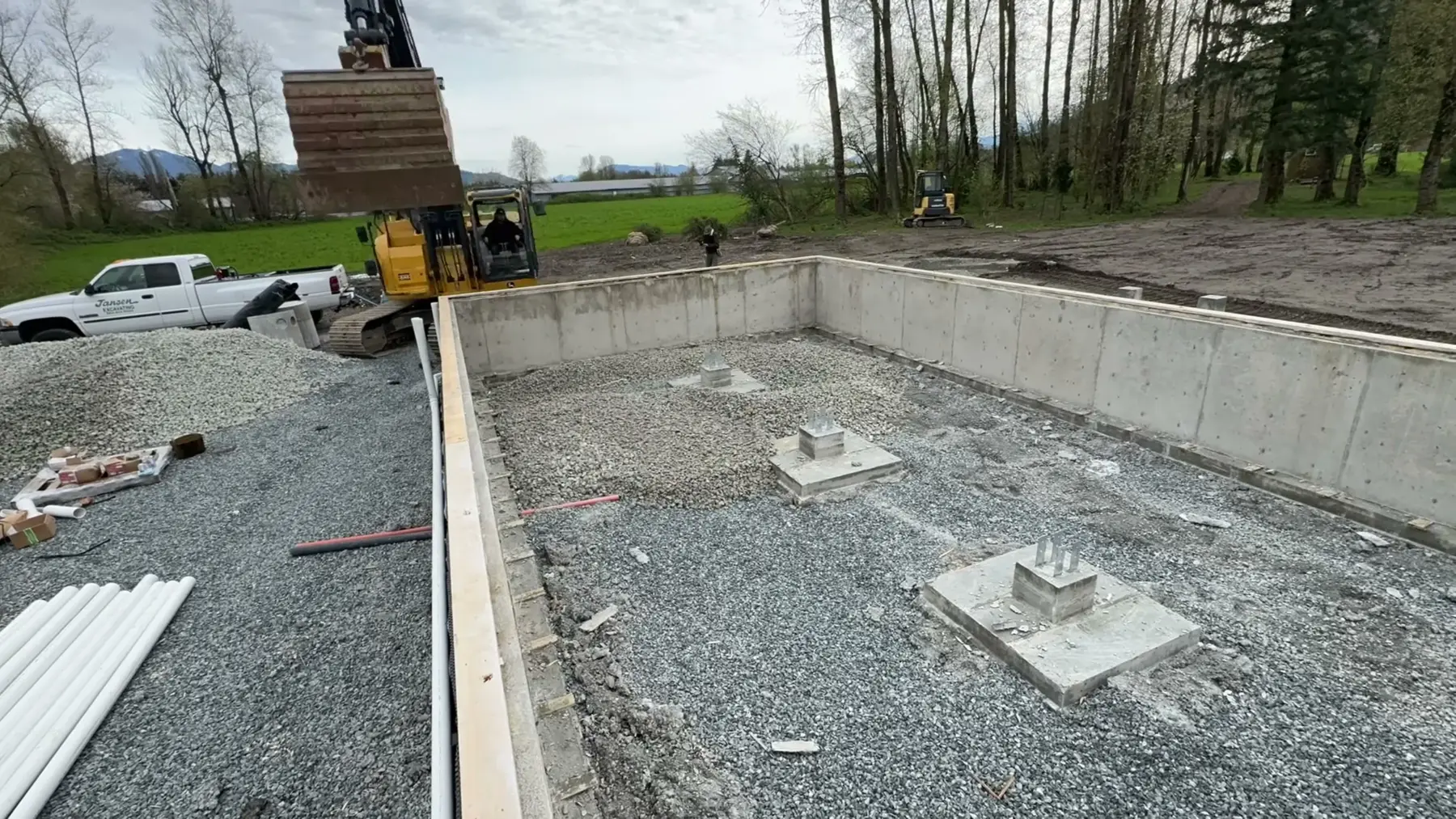
The usual build stacks drain rock and foam board. The one-layer build replaces both with a thicker layer of Enviro-Rock.[1] Enviro-Rock was used this way, in place of foam and clear gravel, on an under-slab job in Yarrow, BC.[5] In both builds, the polyethylene soil gas barrier stays.[2]
Drain rock and foam board
- 1Concrete slab
- 2Polyethylene soil gas barrier
- 3Foam board (EPS or XPS)
- 4Drain rock, at least 100 mm
- 5Radon vent pipe, inlet in the drain rock
The usual build: drain rock, foam board and a polyethylene soil gas barrier under the slab. Schematic, not to scale.
One layer of Enviro-Rock
- 1Concrete slab
- 2Polyethylene soil gas barrier, still required
- 3Geotextile or levelling layer protecting the membrane
- 4Enviro-Rock: drainage, capillary break, gas-permeable layer and insulation
- 5Non-woven geotextile over the subgrade
- 6Radon vent pipe, inlet in the Enviro-Rock
The one-layer build: Enviro-Rock between geotextiles, with the polyethylene soil gas barrier above. Schematic, not to scale.
- 1Excavate deeper to fit the thicker layer, proof-roll the subgrade and lay a non-woven geotextile.[7]
- 2Place Enviro-Rock in loose lifts, 300 to 600 mm under a static roller or 150 to 300 mm under a plate compactor, and compact it 10 to 20%.[7][8]
- 3Set the radon vent pipe inlet in the Enviro-Rock layer.
- 4Cover it with a geotextile or levelling layer, because the Canadian radon standard warns that sharp-edged fill can puncture the soil gas barrier.[6]
- 5Lay the polyethylene soil gas barrier, which is still required.[2]
- 6Pour the slab.
Side by side
Foam glass aggregate vs foam board
| Factor | Foam glass aggregate | Foam board |
|---|---|---|
| What it is | Loose, angular aggregate made from recycled glass, placed in lifts and compacted like other fill.[9][10] | Rigid board of expanded (EPS) or extruded (XPS) polystyrene. Styrofoam is DuPont's trademark for its XPS board, although the word is often used for any polystyrene foam.[11] |
| Density | 160 to 400 kg/m³ across the material class.[9] Enviro-Rock: 200 kg/m³ loose, 240 kg/m³ at 20% compaction.[12] | Minimums of 15 to 46 kg/m³ for EPS Types I to XV and 21 to 48 kg/m³ for XPS, depending on the ASTM C578 type.[13] |
| Insulation per inch | Enviro-Rock's brochure gives R-2.4 per inch as a dry value.[12] Laval University measured a compacted foam glass aggregate sample at three to five times the thermal conductivity of XPS board.[3] | ASTM C578 minimums at 24 °C (75 °F): R-3.6 to R-4.3 per inch for EPS Types I to XV and R-5.0 for XPS.[13] In Canada, CAN/ULC-S701.1 also requires XPS to declare a long-term thermal resistance (LTTR).[14] |
| Thickness for similar frost protection | In a Quebec road trial, 150 mm of foam glass aggregate and 50 mm of XPS gave comparable frost protection over three winters; the foam glass was made three times thicker on its manufacturer's recommendation.[3][15] In a Norwegian road test, frost reached the subgrade under 150 mm of foam glass and under 30 mm of XPS at about the same time in the first winter.[4] | 50 mm in the Quebec trial and 30 mm in the Norwegian test. Both were road trials; neither tested Enviro-Rock or a building slab. |
| Drainage and capillary break | Free-draining, open-graded fill.[16] Under a slab, the same layer drains[1], and its coarse structure helps interrupt capillary rise.[17] | Board does not drain, so it goes over a gravel layer. Building Science Corporation advises installing all under-slab insulation over a granular capillary break[18], and BC's code requires at least 100 mm of clean coarse granular material under floors-on-ground.[2] |
| Radon gas-permeable layer | BC's code accepts as the gas-permeable layer any material that allows effective depressurization[2], and the Canadian radon standard notes that this layer may also do other jobs in the building envelope.[6] | The board sits above the gravel that carries the radon pipe inlet. Where the board is not sealed as a soil gas barrier, the radon standard puts the soil gas barrier above it.[6] |
| Code path as insulation | Not covered by any insulation standard listed in BC's Part 9, so using it as insulation needs an alternative solution accepted by the building official.[2] German approvals for foam glass gravel under foundation slabs set design conductivities of 0.105 to 0.12 W/(m·K).[19][20] | Prescriptive. Polystyrene boards are listed in BC's Part 9 through CAN/ULC-S701.1[2], and the IRC tables for frost-protected shallow foundations allow EPS or XPS.[21] |
| Compressive strength | Measured in confined compression, so the figures cannot be compared directly with board tests. Independent testing of Enviro-Rock reported 918 kPa at 20% deformation (EN 1097-11, modified), an index value for comparing aggregates, not an allowable bearing pressure.[22] | Minimums of 69 to 414 kPa for EPS Types I to XV and 104 to 690 kPa for XPS, at 10% deformation or yield.[13] |
| Water below grade | Insulates less when wet: a Norwegian road study measured about 0.155 W/(m·K) at in-service moisture.[4] German approvals do not allow foam glass gravel in the capillary fringe of groundwater.[19] | About 0.04 W/(m·K) for XPS in the same study.[4] Boards take on water over decades in wet ground, and the published field data on EPS against XPS come from each side of an industry dispute.[23][24] |
| Fire | FHWA lists foam glass aggregate as not flammable[9], and a European Technical Assessment for one cellular glass loose fill declares reaction-to-fire Class A1.[25] | Combustible; manufacturers state it needs a protective or thermal barrier as the building code specifies.[26] BC's code permits it beneath slabs and outside foundation walls below ground.[2] |
| Fuel and solvents | Glass: TAC research notes it does not degrade in the chemicals common in a pavement.[15] | Petrol, coal tar and common solvents attack polystyrene, causing softening, shrinkage and possible dissolution.[27] |
| Insects | In a Norwegian laboratory study, carpenter ants built no nests in cellular glass board, the closest material tested.[28] | Carpenter ants excavated EPS and XPS in the same study[28], and Health Canada notes that they can nest in foam insulation.[29] |
| Buoyancy | Buoyant. Independent testing of Enviro-Rock reported a buoyancy of -412 kg/m³ at a dry density of 298 kg/m³, a net uplift of about 4.0 kN/m³ when submerged.[22] Illinois Tollway research gives about 2.4 kN/m³ (15 lb/ft³) and uses 3.5 kN/m³ (22 lb/ft³) for design.[16] | Buoyant. DuPont calls for enough backfill to ballast the board where flooding or a high water table may submerge it.[30] |
| Raw material and end of life | Enviro-Rock is made from 100% recycled glass[31], and foam glass aggregate can be excavated and reused.[16] | Made from crude oil and natural gas feedstocks.[32] Owens Corning's environmental product declaration for its current XPS says reuse and recycling are possible but no formal collection programs exist, so it assumes landfill at end of life.[33] |
Where foam glass aggregate fits
When foam glass aggregate is the better choice
It fits best under a slab that needs drainage, a capillary break, a radon gas-permeable layer and insulation. One Enviro-Rock layer can do all four jobs in place of drain rock and board[1][17], and BC's code accepts any material that allows effective depressurization as the gas-permeable layer, though its use as insulation needs the building official's acceptance.[2]
It also suits builds where fire, fuel or insects are a concern. A European Technical Assessment rates one cellular glass loose fill Class A1 for reaction to fire[25], glass does not degrade in the chemicals common in a pavement[15], and carpenter ants built no nests in cellular glass board in the one comparative test found.[28]
On soft ground the weight matters too. Enviro-Rock weighs about 90% less than crushed rock[34], so the layer that replaces the gravel also takes load off the soil.
Recycled content and end of life favour it as well. Enviro-Rock is made from 100% recycled glass[31], and foam glass aggregate can be dug up and reused[16], while Owens Corning's XPS declaration assumes landfill because no collection programs exist.[33]
Where foam board fits
When foam board may be the better choice
- The build-up has to stay thin. XPS has a minimum of R-5.0 per inch and EPS Types I to XV R-3.6 to R-4.3[13], so where excavation depth, slab elevation or a high water table limits the layer, board fits where a thicker aggregate layer does not.
- The project needs a prescriptive code path or a standard thermal rating. Polystyrene board is listed in BC's Part 9 through CAN/ULC-S701.1[2], XPS carries a declared long-term thermal resistance[14], and the IRC frost-protected shallow foundation tables credit EPS and XPS.[21]
- The lowest possible weight governs. EPS geofoam at 11 to 48 kg/m³ is several times lighter than any foam glass aggregate.[9]
- The layer has to be an exact thickness. A board arrives at its rated thickness, while a compacted aggregate layer depends on lift thickness and compaction.[7]
- The floor carries heavy sustained loads. High-density XPS reaches 690 kPa at 10% deformation or yield[13], with manufacturer guidance on safety factors against creep[30], while published creep data for foam glass aggregate covers sustained stresses up to about 96 kPa (2,000 psf).[16]
- The job is small. Board is sold by the sheet, while Enviro-Rock ships in bulk trailers or 1.7 m³ super sacks.[35]
Questions
Common questions
Can Enviro-Rock replace Styrofoam under a slab?
Yes, as one thicker layer that replaces the foam board and the drain rock and also drains and gives soil gas a path to the radon pipe.[1][2] Foam glass aggregate is not covered by any insulation standard listed in BC's Part 9, so using it as the insulation needs an engineered design and the building official's acceptance.[2]
How much thicker does the layer need to be?
In road trials, foam glass aggregate layers were three to five times the thickness of XPS for similar frost protection.[3][4] No published side-by-side trial under a building slab was found, so the envelope consultant sets the thickness for each project. Ask for Enviro-Rock's thermal test report and its method.[36]
Do I still need plastic under the slab?
Yes. BC's code requires a polyethylene soil gas barrier under the slab[2], and Enviro-Rock does not replace it. The Canadian radon standard warns that sharp-edged fill can puncture that membrane, so the aggregate gets a protective cover first.[6]
Why do builders put Styrofoam under concrete?
To cut heat loss through the slab. Without a heat-recovery ventilator, BC's Part 9 prescriptive energy tables call for at least RSI 2.32 under heated floors in climate zones 4 to 7A and RSI 1.96 under unheated floors above the frost line, while unheated floors below the frost line can be left uninsulated.[2]
Is EPS the same as Styrofoam?
No. Styrofoam is DuPont's trademark for its extruded polystyrene (XPS) board, although the word is often used for any polystyrene foam.[11] EPS is expanded polystyrene, with ASTM C578 minimums of R-3.6 to R-4.3 per inch for Types I to XV, against R-5.0 for XPS.[13]
Is foam glass aggregate the same as FOAMGLAS?
No. FOAMGLAS is a cellular glass board.[37] Enviro-Rock is a loose aggregate, spread and compacted like other fill.[7]
What is the R-value of foam glass aggregate?
Enviro-Rock's brochure gives R-2.4 per inch as a dry value.[12] Foam glass aggregate insulates less when wet: a Norwegian road study measured about 0.155 W/(m·K) at in-service moisture.[4] German approvals for use under foundation slabs set design values of 0.105 to 0.12 W/(m·K).[19][20]
Does foam board lose R-value in wet ground?
Some. EPS boards dug out from under an Alaska road after 21 years held 4.7 to 21.5% water by volume, in data published by an XPS maker[23], while an EPS industry excavation found that XPS kept 52% of its R-value after 15 years on a Minnesota foundation wall.[24] Each data set comes from one side of the industry.
Sources
- [1] Enviro-Rock Under Slabs: Foam Glass Aggregate Explained (video), Enviro-Corp Recycling
- [2] British Columbia Building Code 2024, Revision 2, Government of British Columbia
- [3] Assessment of mechanical and thermal properties of foam glass aggregate, Transportation Association of Canada and Université Laval, 2019
- [4] Field test comparing frost insulation materials in road construction, SINTEF and Norwegian Public Roads Administration
- [5] Underslab installation of Enviro-Rock in Yarrow, BC (video), Enviro-Corp Recycling
- [6] CAN/CGSB-149.11-2019, Radon control options for new construction in low-rise residential buildings, Canadian General Standards Board
- [7] Enviro-Rock installation guide, Enviro-Corp Recycling
- [8] Enviro-Rock compaction equipment sheet, Enviro-Corp Recycling
- [9] Alternative Backfills for Highway Applications: State of the Practice (FHWA-HRT-23-110), Federal Highway Administration, 2024
- [10] Guidelines for Using Lightweight Fills in Transportation Infrastructure Applications, Texas DOT and University of Texas at Austin, 2025
- [11] Styrofoam is not a cup, DuPont
- [12] Enviro-Rock civil infrastructure brochure (metric), specification table, Enviro-Corp Recycling
- [13] Technical Bulletin 10015702: ASTM C578-23 physical property requirements for polystyrene insulation, Owens Corning, 2025
- [14] CAN/ULC-S701.1:2017, thermal insulation, polystyrene boards: technical criteria, National Research Council Canada, Canadian Construction Materials Centre
- [15] Innovative materials for road insulation in cold climates: foam glass aggregates, Transportation Association of Canada, 2016
- [16] Applications for Foamed Glass Lightweight Aggregate, final report, Illinois Tollway Research Program, Washington State University et al., 2025
- [17] Enviro-Rock benefits: drainage and permeability, Enviro-Corp Recycling
- [18] BSI-118: Concrete Solutions, Building Science Corporation, 2020
- [19] National technical approval Z-23.34-1954, foam glass gravel under foundation slabs, DIBt, Germany, 2025
- [20] National technical approval Z-23.34-1579, foam glass gravel under foundation slabs, DIBt, Germany, 2026
- [21] 2021 International Residential Code, section R403.3, frost-protected shallow foundations, International Code Council (Colorado adoption, UpCodes)
- [22] Foamed glass aggregate as lightweight fill (R. Fenton and J. Thai, Metro Testing + Engineering), Vancouver Geotechnical Society Symposium Proceedings, June 5, 2026
- [23] Technical bulletin on the University of Alaska Fairbanks study of polystyrene insulation under roads, Owens Corning (XPS manufacturer)
- [24] Bulletin 103: EPS below-grade R-value retention, EPS Molders Association (EPS industry), 2008
- [25] European Technical Assessment ETA-13/0549, cellular glass loose fill, DIBt, Germany, 2020
- [26] FOAMULAR NGX 350 data sheet (Canada), Owens Corning
- [27] STYROFOAM chemical resistance, DuPont
- [28] Excavation of building insulation by carpenter ants, Camponotus ligniperda, International Pest Control, 2013
- [29] Carpenter ants, Health Canada
- [30] Styrofoam Brand Highload insulation for geotechnical applications, DuPont, 2023
- [31] Enviro-Rock cellular foam glass aggregate, Enviro-Corp Recycling
- [32] Environmental product declaration, expanded polystyrene insulation, EPS Industry Alliance, 2017
- [33] Environmental product declaration SCS-EPD-09753, FOAMULAR NGX XPS insulation, Owens Corning, 2024
- [34] Enviro-Rock benefits: lightweight, Enviro-Corp Recycling
- [35] Enviro-Rock delivery trailer overview, Enviro-Corp Recycling
- [36] Enviro-Rock technical data, Enviro-Corp Recycling
- [37] FOAMGLAS cellular glass insulation, Owens Corning
Talk to the team behind Enviro-Rock.
Ask for test reports, a sample or a price for your project, and a person replies. For product and availability questions, call the AI information line any time, and ask to speak with sales directly.