Cold regions
Frost insulation for roads, pavements and foundations
Enviro-Rock is a non-frost-susceptible aggregate[1] that also insulates.[2] For frost design, use an in-service conductivity: a Norwegian road study measured foam glass aggregate at about 0.155 W/(m·K) at in-service moisture.[3]
- 1Winter cold driving down from the surface
- 2Asphalt and granular base
- 3Foam glass aggregate insulating layer
- 4Frost line held above the insulation
- 5Less frost reaches the frost-susceptible subgrade
An insulating foam glass aggregate layer limits how far frost reaches into the frost-susceptible subgrade. Schematic, not to scale.
Frost protection
The engineering problem
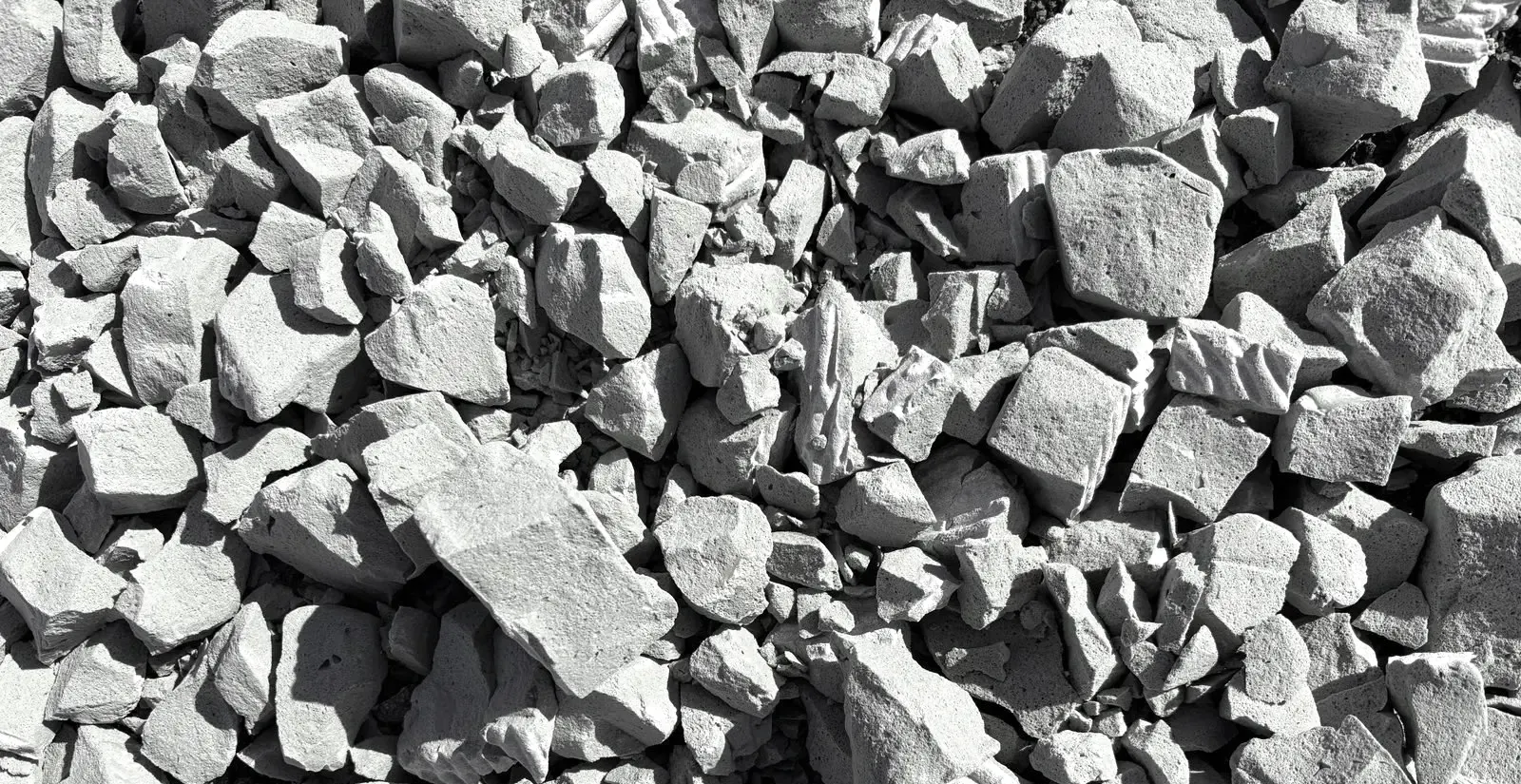
Frost heave starts when freezing reaches a frost-susceptible soil with water available. A fine soil matrix contributes to frost-heave development.[1]
The conventional fix is depth: thick layers of non-frost-susceptible granular material over the subgrade, which means deeper excavation and more imported fill.
Extruded polystyrene boards insulate well in thin layers, but they are a separate product to place and protect, and they dissolve on contact with hydrocarbon spills.[4]
Benefits
What Enviro-Rock adds
01
Used as road insulation in Norway
Foam glass aggregate is one of three materials Norway uses regularly as thermal insulation in roads.[3] In the first, mild winter of a Quebec field trial, 150 mm of foam glass aggregate insulated a pavement about as well as 50 mm of extruded polystyrene board.[4]
02
Thinner insulated structures under study
Under Norway's current guidelines, an insulated structure for a new E6 section needed 202 cm against 240 cm with crushed rock alone. NTNU's numerical analysis suggests 132 cm, including 60 cm of foam glass or lightweight aggregate insulation, might be enough, which would need a change to the guideline method.[5]
03
Enviro-Rock's freeze-thaw data
Enviro-Rock had a 4.0% weighted loss in the CSA A23.2-24A unconfined freeze-thaw test. The test's reference aggregate lost 14.2%, inside the range that shows the test run was valid.[6]
On site
How it goes in
- 1
Design the thermal layer
The thickness comes from a frost design for the site's climate and soils, using an in-service conductivity rather than a dry value: a Norwegian road study measured foam glass aggregate at about 0.155 W/(m·K) at in-service moisture, higher than dry lab values.[3]
- 2
Prepare and separate
Proof-roll the subgrade and lay a non-woven geotextile for separation.[7]
- 3
- 4
Cover the insulation
Cap with geotextile and the crushed gravel base and pavement the design calls for above the insulating layer.[7]
Specs that matter here
Key properties
| Property | Value |
|---|---|
| Dry bulk density | 200 kg/m³ loose (12.5 lb/ft³)[6]240 kg/m³ (15.0 lb/ft³) at 20% compaction. For design, use a moist, compacted unit weight: PennDOT practice and the Illinois Tollway design guide use 376 kg/m³ (23.5 lb/ft³) for foam glass aggregate[10], and the Kelowna design used about 2.5 kN/m³ compacted.[11] The engineer of record sets the project value. |
| Confined compressive resistance | 1.01 MPa (147 psi) at 20% deformation[6]0.56 MPa at 10% and 1.67 MPa at 30%.[6] Tested by modified EN 1097-11.[12] An index value for comparing aggregates, not an allowable bearing pressure. |
| Thermal resistance | RSI 0.42 per 25 mm (R-2.4 per inch), dry test value[6]Enviro-Rock's test reports include thermal resistivity by ASTM D5334.[12] Its thermal page gives a design value of approximately R-2 per inch.[2] Moisture in service raises the conductivity of foam glass aggregate[3], so the energy or frost designer sets the design value, and the authority having jurisdiction decides what it accepts for a loose fill. |
| Freeze-thaw loss | 4.0% weighted loss (CSA A23.2-24A, unconfined)[6]The test's reference aggregate lost 14.2%, within the 8.5 to 15.3% limits the method sets for it, which shows the test run was valid. It is a calibration check, not a comparison with ordinary aggregate.[6] |
| Water absorption | 7.2%, uncompacted[6]A weighted average by modified ASTM C127.[13] Absorption of foam glass aggregate rises with soaking time: Indiana DOT specifies 30 to 60% by weight after 28 days.[14] Allow for in-service moisture in the design unit weight and thermal values. |
| Placement and compaction | 300 to 600 mm loose lifts under a static roller, or 150 to 300 mm under a plate compactor; compact 10 to 20%[7][8]No vibration on rollers, to prevent particle breakdown.[7] With a plate compactor, use more passes rather than more vibration, and do not use a jumping jack.[8] Allow about 20% reduction from loose thickness.[9] |
Industries
Who builds with it
Roles
Who specifies and installs it
Questions
Frost protection: common questions
What is the R-value of foam glass aggregate?
Enviro-Rock's dry test value is R-2.4 per inch[6], and its thermal page gives a design value of approximately R-2 per inch.[2] Moisture in service raises the conductivity of foam glass aggregate, so frost designs use an in-service value that the frost designer sets from field data and project testing.[3]
How thick does a foam glass frost insulation layer need to be?
It comes from a thermal design for the site. In field trials, 150 mm of foam glass aggregate performed about like 50 mm of extruded polystyrene in the first, mild winter in Quebec[4], and like 30 mm in a first-winter Norwegian test.[3]
How does an insulation layer stop frost heave?
It slows the loss of heat from the ground below, so less frost penetrates, and the design sets the thickness that keeps frost out of the susceptible soil for the design winter.[3] Enviro-Rock adds an aggregate layer without the fine soil matrix that contributes to heave.[1]
Can foam glass aggregate replace rigid foam in a frost-protected shallow foundation?
Enviro-Rock can provide insulation around foundations[2], but a frost-protected shallow foundation needs a thermal design by the engineer of record. That design uses effective in-ground values, so it should not be sized from Enviro-Rock's dry or design R-value without project testing, and the authority having jurisdiction decides what it accepts for a loose fill.
Is Enviro-Rock accepted for northern highway work?
In BC, it is an accepted lightweight fill on the Ministry of Transportation and Transit Recognized Products List.[15] Alberta lists it as a potential product and has no experience with it yet.[16][17] Enviro-Rock is not on a Yukon or Alaska product list, so acceptance there rests with the project owner and the engineer of record.
Does a light aggregate make sense for remote sites?
Shipping distance significantly affects the cost of foam glass aggregate[18], but a truckload of lightweight fill is limited by volume rather than weight[19], and an Enviro-Rock B-train carries up to 140 m³.[20] Delivery covers BC, Alberta, Washington, Oregon and California[21]; for other sites, ask when you request a quote.
Sources
- [1] Enviro-Rock benefits: frost resistance, Enviro-Corp Recycling
- [2] Enviro-Rock benefits: thermal insulation, Enviro-Corp Recycling
- [3] Field test comparing frost insulation materials in road construction, SINTEF and Norwegian Public Roads Administration
- [4] Innovative materials for road insulation in cold climates: foam glass aggregates, 2016, Transportation Association of Canada conference paper (Laval University)
- [5] Design of roads using frost insulation materials: case study new E6 in Hedmark, Norway, 2019, Norwegian University of Science and Technology (NTNU)
- [6] Enviro-Rock civil infrastructure brochure (metric), specification table, Enviro-Corp Recycling
- [7] Enviro-Rock installation guide, Enviro-Corp Recycling
- [8] Enviro-Rock compaction equipment sheet, Enviro-Corp Recycling
- [9] Enviro-Rock installation, Enviro-Corp Recycling
- [10] Applications for Foamed Glass Lightweight Aggregate, final report, Illinois Tollway Research Program, Washington State University et al., 2025
- [11] Case study: 6-storey building, Kelowna, Enviro-Corp Recycling
- [12] Enviro-Rock technical data, Enviro-Corp Recycling
- [13] Enviro-Rock benefits: closed-cell structure, Enviro-Corp Recycling
- [14] 904-M-076 Lightweight Aggregate, Indiana DOT, 2025
- [15] Recognized Products List, Lightweight Fill Material (October 1, 2026), BC Ministry of Transportation and Transit
- [16] Product evaluation: Enviro-Rock (8165-5-7), Alberta Transportation and Economic Corridors
- [17] Products List: Lightweight Fill (March 18, 2026), Alberta Transportation and Economic Corridors
- [18] Applications for Foamed Glass Lightweight Aggregate, final report with draft special provision and design guide, 2025, Illinois Tollway Research Program; Washington State University, Lafayette College and UW-Madison
- [19] Guidelines for Using Lightweight Fills in Transportation Infrastructure Applications (FHWA/TX-26/0-7237-1), 2025, Texas Department of Transportation and the Center for Transportation Research, UT Austin
- [20] Enviro-Rock delivery trailer overview, Enviro-Corp Recycling
- [21] Frequently asked questions, Enviro-Corp Recycling
Get a price and a delivery window.
Tell us the application, the volume and where it is going. A real person replies with pricing and a delivery window.