What it is
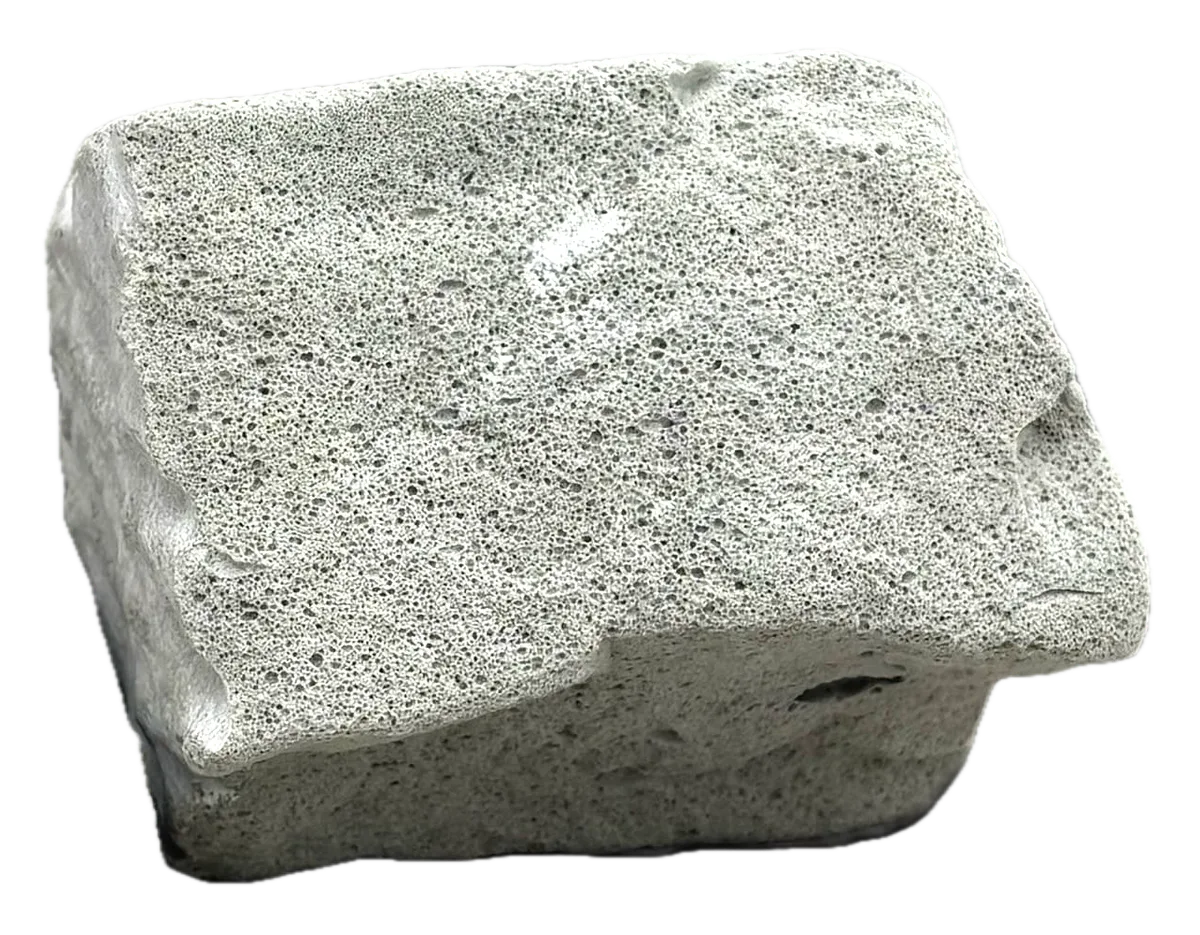
What it is and how it is made
Enviro-Rock starts as recycled glass, ground into a fine powder of consistent particle size. The powder is blended with a foaming agent and heated in a furnace, where the glass softens and expands into a lightweight cellular structure. It is then cooled and processed to aggregate size.[3]
The cells inside each particle are sealed. They limit how much water enters each piece, while the open spaces between pieces let water move freely through the placed fill.[4]
The result is a fill that reduces structural and ground loading while providing free drainage, thermal insulation, frost resistance and long-term durability.[2] It is made in Quesnel, BC, from glass collected across the province.[5][1]
Technical data
Engineering properties
From the Enviro-Rock specification table and product pages. Design values for a project are confirmed by the engineer of record from test data and site conditions.
| Property | Value |
|---|---|
| Dry bulk density | 200 kg/m³ loose (12.5 lb/ft³)[1]240 kg/m³ (15.0 lb/ft³) at 20% compaction. For design, use a moist, compacted unit weight: PennDOT practice and the Illinois Tollway design guide use 376 kg/m³ (23.5 lb/ft³) for foam glass aggregate[6], and the Kelowna design used about 2.5 kN/m³ compacted.[7] The engineer of record sets the project value. |
| Average grain size | 25 to 75 mm (1 to 3 in)[1]A sieve analysis (ASTM C136) is available on request.[8] |
| Confined compressive resistance | 1.01 MPa (147 psi) at 20% deformation[1]0.56 MPa at 10% and 1.67 MPa at 30%.[1] Tested by modified EN 1097-11.[8] An index value for comparing aggregates, not an allowable bearing pressure. |
| Angle of friction | 39° at 65 kPa normal stress[1]The friction angle of foam glass aggregate falls as normal stress rises[6], so the geotechnical engineer selects the design value for the stress on the project from test data and design conditions.[9] |
| Thermal resistance | RSI 0.42 per 25 mm (R-2.4 per inch), dry test value[1]Enviro-Rock's test reports include thermal resistivity by ASTM D5334.[8] Its thermal page gives a design value of approximately R-2 per inch.[10] Moisture in service raises the conductivity of foam glass aggregate[11], so the energy or frost designer sets the design value, and the authority having jurisdiction decides what it accepts for a loose fill. |
| Freeze-thaw loss | 4.0% weighted loss (CSA A23.2-24A, unconfined)[1]The test's reference aggregate lost 14.2%, within the 8.5 to 15.3% limits the method sets for it, which shows the test run was valid. It is a calibration check, not a comparison with ordinary aggregate.[1] |
| Water absorption | 7.2%, uncompacted[1]A weighted average by modified ASTM C127.[4] Absorption of foam glass aggregate rises with soaking time: Indiana DOT specifies 30 to 60% by weight after 28 days.[12] Allow for in-service moisture in the design unit weight and thermal values. |
| Intergranular void space | 50% loose, 30% at 20% compaction[1]The brochure notes these figures are based on worldwide averages. Open-graded, so water drains through the fill and capillary rise is interrupted.[13] No permeability value is published; ask for a test if the design needs one. |
| California bearing ratio | 5.1% at 2.54 mm penetration[1]6.8% at 5.08 mm. Tested at 292 kg/m³ dry density, denser than the published 240 kg/m³ at 20% compaction. The installation guide places a crushed gravel base between the fill and the pavement.[14] |
| Placement and compaction | 300 to 600 mm loose lifts under a static roller, or 150 to 300 mm under a plate compactor; compact 10 to 20%[14][15]No vibration on rollers, to prevent particle breakdown.[14] With a plate compactor, use more passes rather than more vibration, and do not use a jumping jack.[15] Allow about 20% reduction from loose thickness.[16] |
| Recycled content | 100% recycled glass[2] |
| Fire | Glass; does not burn[2]No fire test to a named standard, such as CAN/ULC-S114, has been published for Enviro-Rock. |
Supply
Sizes, forms and delivery
01
Grain size, 25 to 75 mm
Enviro-Rock's specification table gives an average grain size of 25 to 75 mm (1 to 3 in).[1] A sieve analysis (ASTM C136) is available on request.[8]
02
Large trailers, up to 140 m³
A B-train of two 30 ft end-dump trailers carries up to 140 m³ (about 183 yd³), and a 52 ft shuffle floor trailer up to 106 m³ (138 yd³).[17]
03
Smaller trailers, about 45 m³
An end-dump trailer carries up to 45 m³ (59 yd³), and a truck and pup up to 45.7 m³ (59.7 yd³).[17]
04
Super sacks, 1.7 m³ each
Bagged at 1.7 m³ (2.2 yd³) per sack, up to 102 m³ per load.[17] No minimum order is published, so ask when you request a quote.
05
Supply and pickup
Delivered from Enviro-Rock's BC facilities, including a stockpile in the Fraser Valley.[18] Pickup from the Quesnel facility is available by appointment.[19]
06
Samples
A sample tin of Enviro-Rock pieces is available on request, so you can see and handle the material before you specify it.[20]
Documents
For your submittal package
- Civil infrastructure brochure with specification tablePDF ↗
- Building construction brochurePDF ↗
- Installation guidePDF ↗
- Compaction equipment sheetPDF ↗
- Delivery trailer overviewPDF ↗
- Safety data sheetOn request →
- Test reports: ASTM C29, C127, C136, D1557, D1883, D5334On request →
- Test reports: CSA A23.2-24A, EN 1097-11 (modified)On request →
Questions
Product questions
What sizes does Enviro-Rock come in?
The specification table gives an average grain size of 25 to 75 mm (1 to 3 in).[1] Ask about gradation for your application when you request a quote.
Which test reports are available?
Bulk density (ASTM C29), water absorption (ASTM C127), sieve analysis (ASTM C136), ASTM D1557, CBR (ASTM D1883), thermal resistivity (ASTM D5334), freeze-thaw (CSA A23.2-24A) and compressibility (modified EN 1097-11), on request.[8]
Does Enviro-Rock absorb water?
Water absorption is 7.2% uncompacted, a weighted average by modified ASTM C127.[1][4] Absorption of foam glass aggregate rises with soaking time, and Indiana DOT specifies 30 to 60% by weight after 28 days[12], so allow for in-service moisture in design weights and thermal values.
Is it hazardous to handle?
The safety data sheet lists it as 100% recycled glass, not classified as hazardous, with dust and eye precautions for dusty conditions.[21]
How much does it compact?
Compact 10 to 20%: under a static roller with no vibration in 300 to 600 mm loose lifts, or under a plate compactor in 150 to 300 mm loose lifts with more passes rather than more vibration.[14][15] Allow about a 20% reduction from loose thickness unless the design says otherwise.[16]
Sources
- [1] Enviro-Rock civil infrastructure brochure (metric), specification table, Enviro-Corp Recycling
- [2] Enviro-Rock cellular foam glass aggregate, Enviro-Corp Recycling
- [3] How Enviro-Rock is made, Enviro-Corp Recycling
- [4] Enviro-Rock benefits: closed-cell structure, Enviro-Corp Recycling
- [5] Abbotsford's Enviro-Corp Recycling transforming glass into rocks, Langley Advance Times
- [6] Applications for Foamed Glass Lightweight Aggregate, final report, Illinois Tollway Research Program, Washington State University et al., 2025
- [7] Case study: 6-storey building, Kelowna, Enviro-Corp Recycling
- [8] Enviro-Rock technical data, Enviro-Corp Recycling
- [9] Enviro-Rock benefits: angle of friction, Enviro-Corp Recycling
- [10] Enviro-Rock benefits: thermal insulation, Enviro-Corp Recycling
- [11] Field test comparing frost insulation materials in road construction, SINTEF and Norwegian Public Roads Administration
- [12] 904-M-076 Lightweight Aggregate, Indiana DOT, 2025
- [13] Enviro-Rock benefits: drainage and permeability, Enviro-Corp Recycling
- [14] Enviro-Rock installation guide, Enviro-Corp Recycling
- [15] Enviro-Rock compaction equipment sheet, Enviro-Corp Recycling
- [16] Enviro-Rock installation, Enviro-Corp Recycling
- [17] Enviro-Rock delivery trailer overview, Enviro-Corp Recycling
- [18] Delivering Enviro-Rock to downtown Vancouver from the Fraser Valley stockpile (video), Enviro-Corp Recycling
- [19] Frequently asked questions, Enviro-Corp Recycling
- [20] Enviro-Rock samples, Enviro-Corp Recycling
- [21] Safety data sheet, foam glass aggregate (November 2024), United Concrete & Gravel Ltd.
Get a price and a delivery window.
Tell us the application, the volume and where it is going. A real person replies with pricing and a delivery window.