Civil infrastructure
Lightweight fill for roads and embankments on soft ground
Enviro-Rock weighs about 200 kg/m³ (12.5 lb/ft³) loose[1], about 90% lighter than conventional crushed rock, so an embankment or grade raise adds far less load to the soft ground below.[2]
- 1Pavement and base course
- 2Foam glass aggregate core, wrapped in geotextile
- 3Soft, compressible soil
- 4A lighter embankment puts less load on the soft ground
A foam glass aggregate core wrapped in geotextile replaces heavy fill, so the embankment puts less load on the soft ground. Schematic, not to scale.
Soft ground embankments
The engineering problem
Mineral soils and aggregates weigh about 1,500 to 2,400 kg/m³ (95 to 150 lb/ft³).[3] Every metre of conventional fill in an embankment, grade raise or road widening adds that weight to the ground below, and on soft clay, silt or peat the added load is what drives settlement.
The conventional options work around the load: preload and wait for the ground to consolidate, dig out and replace the soft soil, or carry the structure on deep foundations. On a road widening, the new fill settles while the old road beside it has largely finished settling.
Lightweight fill reduces the load itself. At Jim Lorimer Park in Burnaby, the design with a 500 mm layer of Enviro-Rock projects settlement of roughly 200 mm, down from around 600 mm.[4]
Benefits
What Enviro-Rock adds
01
Far less load on soft ground
Enviro-Rock weighs about 200 kg/m³ (12.5 lb/ft³) loose and 240 kg/m³ (15.0 lb/ft³) at 20% compaction.[1] Less added load means less consolidation of the soil below.
02
Accepted for BC Ministry work
Enviro-Rock is an accepted product in the Lightweight Fill Material category of the BC Ministry of Transportation and Transit Recognized Products List, so it may be used on Ministry projects as long as it meets the requirements of the Standard Specifications and/or the Work.[5] Alberta lists it as a potential product, with final acceptance based on field performance.[6][7]
On site
How it goes in
- 1
Prepare the subgrade
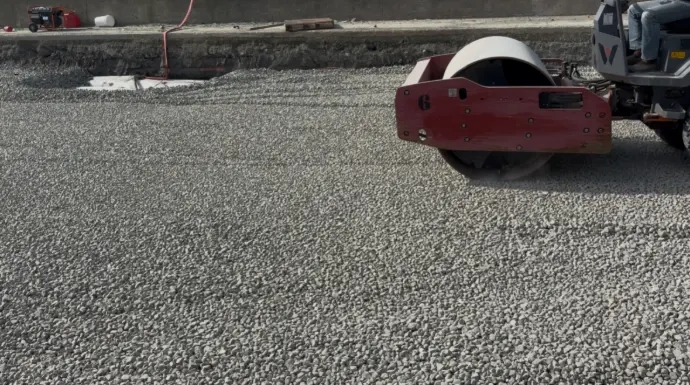
Prepare the subgrade as the geotechnical design requires, proof-rolling where the ground can carry it, and lay non-woven geotextile for separation.[10]
- 2
- 3
- 4
Specs that matter here
Key properties
| Property | Value |
|---|---|
| Dry bulk density | 200 kg/m³ loose (12.5 lb/ft³)[1]240 kg/m³ (15.0 lb/ft³) at 20% compaction. For design, use a moist, compacted unit weight: PennDOT practice and the Illinois Tollway design guide use 376 kg/m³ (23.5 lb/ft³) for foam glass aggregate[14], and the Kelowna design used about 2.5 kN/m³ compacted.[15] The engineer of record sets the project value. |
| Confined compressive resistance | 1.01 MPa (147 psi) at 20% deformation[1]0.56 MPa at 10% and 1.67 MPa at 30%.[1] Tested by modified EN 1097-11.[16] An index value for comparing aggregates, not an allowable bearing pressure. |
| Angle of friction | 39° at 65 kPa normal stress[1]The friction angle of foam glass aggregate falls as normal stress rises[14], so the geotechnical engineer selects the design value for the stress on the project from test data and design conditions.[9] |
| Intergranular void space | 50% loose, 30% at 20% compaction[1]The brochure notes these figures are based on worldwide averages. Open-graded, so water drains through the fill and capillary rise is interrupted.[8] No permeability value is published; ask for a test if the design needs one. |
| Placement and compaction | 300 to 600 mm loose lifts under a static roller, or 150 to 300 mm under a plate compactor; compact 10 to 20%[10][11]No vibration on rollers, to prevent particle breakdown.[10] With a plate compactor, use more passes rather than more vibration, and do not use a jumping jack.[11] Allow about 20% reduction from loose thickness.[12] |
Industries
Who builds with it
Questions
Soft ground embankments: common questions
How does lightweight fill reduce settlement?
Settlement on soft soil follows the load placed on it, so a lighter fill of the same height causes less. At Jim Lorimer Park, the design with a 500 mm Enviro-Rock layer projects roughly 200 mm of settlement instead of around 600 mm.[4] On a Virginia project reviewed for PennDOT, estimated settlement at the deepest fill stations was 10 mm with foam glass aggregate, against 15 to 18 mm with No. 57 stone.[17]
How thick is a typical foam glass embankment layer?
It depends on the load reduction the design needs. Research for PennDOT describes foam glass aggregate fill layers of about 0.3 to 2 m, with 1 to 2 m typical for embankments.[17] Enviro-Rock goes in as 300 to 600 mm loose lifts.[10]
Does foam glass aggregate need a geotextile wrap?
Yes. Enviro-Rock's installation guide calls for non-woven geotextile below the fill and a geotextile or filter cloth layer above it.[10] Agency specifications for foam glass aggregate, such as Maine DOT's, require full geotextile encapsulation.[18]
Can trucks drive on placed foam glass aggregate?
No. Wheeled machines stay off placed Enviro-Rock.[12] Traffic runs on the crushed gravel base and pavement built above it.[10]
Will the fill float if the site floods?
It can. Foam glass aggregate is buoyant, so designs keep it above the water table or hold it down with enough cover.[13] The Jim Lorimer Park design anchored the Enviro-Rock layer against uplift because the site floods seasonally.[4]
What drives the delivered cost?
Material price and shipping distance. Illinois Tollway research found that shipping distance significantly affects the cost of foam glass aggregate.[13] A truckload of lightweight fill is limited by volume rather than weight[19], and an Enviro-Rock B-train carries up to 140 m³ per load.[20]
Sources
- [1] Enviro-Rock civil infrastructure brochure (metric), specification table, Enviro-Corp Recycling
- [2] Enviro-Rock benefits: lightweight, Enviro-Corp Recycling
- [3] Alternative Backfills for Highway Applications: State of the Practice (FHWA-HRT-23-110), 2024, Federal Highway Administration, Turner-Fairbank Highway Research Center
- [4] Case study: Jim Lorimer Park playground, Burnaby, Enviro-Corp Recycling
- [5] Recognized Products List, Lightweight Fill Material (October 1, 2026), BC Ministry of Transportation and Transit
- [6] Product evaluation: Enviro-Rock (8165-5-7), Alberta Transportation and Economic Corridors
- [7] Products List: Lightweight Fill (March 18, 2026), Alberta Transportation and Economic Corridors
- [8] Enviro-Rock benefits: drainage and permeability, Enviro-Corp Recycling
- [9] Enviro-Rock benefits: angle of friction, Enviro-Corp Recycling
- [10] Enviro-Rock installation guide, Enviro-Corp Recycling
- [11] Enviro-Rock compaction equipment sheet, Enviro-Corp Recycling
- [12] Enviro-Rock installation, Enviro-Corp Recycling
- [13] Applications for Foamed Glass Lightweight Aggregate, final report with draft special provision and design guide, 2025, Illinois Tollway Research Program; Washington State University, Lafayette College and UW-Madison
- [14] Applications for Foamed Glass Lightweight Aggregate, final report, Illinois Tollway Research Program, Washington State University et al., 2025
- [15] Case study: 6-storey building, Kelowna, Enviro-Corp Recycling
- [16] Enviro-Rock technical data, Enviro-Corp Recycling
- [17] Lightweight and Sustainable Materials in Engineered Fills (FHWA-PA-2021-011), 2021, Pennsylvania Department of Transportation and Temple University
- [18] Special Provision Section 203: Ultra-Lightweight Foamed Glass Aggregate, 2025, Maine Department of Transportation
- [19] Guidelines for Using Lightweight Fills in Transportation Infrastructure Applications (FHWA/TX-26/0-7237-1), 2025, Texas Department of Transportation and the Center for Transportation Research, UT Austin
- [20] Enviro-Rock delivery trailer overview, Enviro-Corp Recycling
Get a price and a delivery window.
Tell us the application, the volume and where it is going. A real person replies with pricing and a delivery window.