Civil infrastructure
Lightweight backfill that puts less pressure on retaining walls
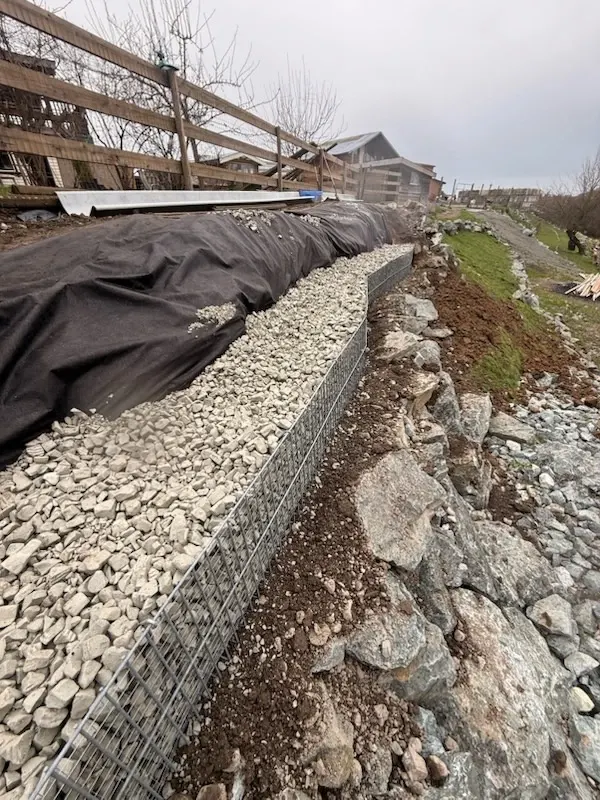
The US Federal Highway Administration states that the low weight and high friction angle of foam glass aggregate can reduce vertical and lateral forces by more than one-half.[1] Enviro-Rock is used behind MSE, cast-in-place and segmental walls.[2]
- 1Wall, abutment or foundation wall
- 2Foam glass aggregate backfill
- 3Lower lateral pressure on the wall
- 4Free-draining fill and drain
- 5Native soil
Light, free-draining foam glass aggregate behind the wall lowers the lateral pressure the wall has to resist. Schematic, not to scale.
Retaining wall backfill
The engineering problem
Most of the load on a retaining wall comes from the weight of the soil behind it. Mineral soils and aggregates weigh about 1,500 to 2,400 kg/m³ (95 to 150 lb/ft³)[1], and the wall, its footing and its reinforcement are sized to hold that weight back.
Water adds to it. Backfill that drains poorly lets water build up behind the wall, and the water pressure adds to the earth pressure.
Where the wall sits on soft ground, or an existing wall has to carry a higher grade, a bigger wall is often not an option. The backfill is the part of the design that can change.
Benefits
What Enviro-Rock adds
01
Less weight behind the wall
Enviro-Rock weighs about 200 kg/m³ (12.5 lb/ft³) loose[3], against 1,500 to 2,400 kg/m³ for mineral soils and aggregates.[1] Less weight in the backfill means less earth pressure for the wall and footing to resist.
On site
How it goes in
- 1
Size the lightweight zone
The geotechnical engineer sets the extent of the fill. Design guidance for foam glass aggregate carries it beyond the active wedge, or makes the fill next to it stable on its own, so heavier fill does not push through it onto the wall.[5]
- 2
Separate from native soil
Line the excavation with non-woven geotextile so native fines stay out of the backfill.[7]
- 3
- 4
Specs that matter here
Key properties
| Property | Value |
|---|---|
| Dry bulk density | 200 kg/m³ loose (12.5 lb/ft³)[3]240 kg/m³ (15.0 lb/ft³) at 20% compaction. For design, use a moist, compacted unit weight: PennDOT practice and the Illinois Tollway design guide use 376 kg/m³ (23.5 lb/ft³) for foam glass aggregate[9], and the Kelowna design used about 2.5 kN/m³ compacted.[10] The engineer of record sets the project value. |
| Confined compressive resistance | 1.01 MPa (147 psi) at 20% deformation[3]0.56 MPa at 10% and 1.67 MPa at 30%.[3] Tested by modified EN 1097-11.[11] An index value for comparing aggregates, not an allowable bearing pressure. |
| Angle of friction | 39° at 65 kPa normal stress[3]The friction angle of foam glass aggregate falls as normal stress rises[9], so the geotechnical engineer selects the design value for the stress on the project from test data and design conditions.[4] |
| Intergranular void space | 50% loose, 30% at 20% compaction[3]The brochure notes these figures are based on worldwide averages. Open-graded, so water drains through the fill and capillary rise is interrupted.[6] No permeability value is published; ask for a test if the design needs one. |
| Placement and compaction | 300 to 600 mm loose lifts under a static roller, or 150 to 300 mm under a plate compactor; compact 10 to 20%[7][8]No vibration on rollers, to prevent particle breakdown.[7] With a plate compactor, use more passes rather than more vibration, and do not use a jumping jack.[8] Allow about 20% reduction from loose thickness.[12] |
Industries
Who builds with it
Questions
Retaining wall backfill: common questions
What is the best backfill for a retaining wall?
A free-draining granular fill that the wall is designed for. Where wall load governs, a lightweight fill lowers the earth pressure: Enviro-Rock's building brochure states that it significantly lowers lateral earth pressures compared with traditional granular backfill.[13] The final wall design uses the project-specific material properties.[2]
How much does foam glass backfill reduce lateral earth pressure?
FHWA states that foam glass aggregate can reduce vertical and lateral forces by more than one-half.[1] The figure for a given wall depends on its geometry, surcharge and design friction angle, and the engineer of record calculates it.[2]
How much backfill is needed behind a retaining wall?
Enough to cover the soil wedge that pushes on the wall. Design guidance for foam glass aggregate extends the lightweight zone past the active wedge unless the fill beside it is stable on its own.[5]
Does retaining wall backfill need drainage?
Yes. Enviro-Rock drains freely, but the water it collects still needs a drain and an outlet, and those belong in the wall design.[6]
Can it be used in MSE walls with steel reinforcement?
MSE walls are one of the wall types Enviro-Rock is used with.[2] Foam glass aggregate tests alkaline by several methods, and Illinois Tollway testing measured pH and resistivity outside the Illinois DOT limits for MSE backfill[5], so ask for Enviro-Rock's chemical test data[14] and have the wall designer check it against the reinforcement.
Sources
- [1] Alternative Backfills for Highway Applications: State of the Practice (FHWA-HRT-23-110), 2024, Federal Highway Administration, Turner-Fairbank Highway Research Center
- [2] Enviro-Rock applications: retaining wall backfill, Enviro-Corp Recycling
- [3] Enviro-Rock civil infrastructure brochure (metric), specification table, Enviro-Corp Recycling
- [4] Enviro-Rock benefits: angle of friction, Enviro-Corp Recycling
- [5] Applications for Foamed Glass Lightweight Aggregate, final report with draft special provision and design guide, 2025, Illinois Tollway Research Program; Washington State University, Lafayette College and UW-Madison
- [6] Enviro-Rock benefits: drainage and permeability, Enviro-Corp Recycling
- [7] Enviro-Rock installation guide, Enviro-Corp Recycling
- [8] Enviro-Rock compaction equipment sheet, Enviro-Corp Recycling
- [9] Applications for Foamed Glass Lightweight Aggregate, final report, Illinois Tollway Research Program, Washington State University et al., 2025
- [10] Case study: 6-storey building, Kelowna, Enviro-Corp Recycling
- [11] Enviro-Rock technical data, Enviro-Corp Recycling
- [12] Enviro-Rock installation, Enviro-Corp Recycling
- [13] Enviro-Rock building construction brochure (metric), Enviro-Corp Recycling
- [14] Enviro-Rock benefits: chemical resistance, Enviro-Corp Recycling
Get a price and a delivery window.
Tell us the application, the volume and where it is going. A real person replies with pricing and a delivery window.