Challenges
Common site problems
01
Too many layers under the slab
Built conventionally, the area under a slab takes a clear stone layer for drainage, capillary break and, where required, radon venting, plus rigid foam board for insulation, each placed and inspected on its own.
02
Pressure on basement and pool walls
Heavy backfill pushes on basement walls and pool shells, and backfill that drains poorly holds water against them.
03
Heat lost to the ground
Heated slabs, driveways and pools lose heat downward into cold soil unless something under them insulates.
Where Enviro-Rock fits
How Enviro-Rock helps
01
Under-slab fill that insulates
Enviro-Rock is used for below-slab thermal insulation and as the gas-permeable layer in radon-control assemblies.[1] Its dry test value is R-2.4 per inch[3]; moisture in service raises the conductivity of foam glass aggregate[5], so the energy designer sets the design value, and the authority having jurisdiction decides what it accepts for a loose fill.
02
A path for soil gas
Its open-graded structure lets soil gases such as radon move freely toward collection piping or a depressurization system.[6]
03
Lighter, draining backfill
Enviro-Rock backfills basement and foundation walls, deep residential excavations and additions.[2] FHWA states that the low weight and high friction angle of foam glass aggregate can reduce vertical and lateral forces by more than one-half.[7]
04
Pools and hot tubs
It goes beneath pool foundations, as backfill around pool walls and shells, and around hot tubs and other heated water structures.[8]
Applications
Used most in residential construction
Application
Retaining wall backfill
Free-draining foam glass aggregate backfill for MSE, cast-in-place and segmental retaining walls, where a lighter fill means less lateral earth pressure on the wall.
Application
Under-slab insulation
One layer of foam glass aggregate under a slab on grade that insulates, drains, breaks capillary rise and gives soil gas a path to a radon system.
Application
Frost protection
An insulating, non-frost-susceptible foam glass aggregate layer that reduces frost penetration into susceptible subgrades under roads, pavements and foundations in cold regions.
Application
Basements, pools and driveways
Free-draining, insulating foam glass aggregate backfill for basement and foundation walls, swimming pools, hot tubs and heated driveways, in bulk loads or 1.7 m³ super sacks.
Questions
Common questions
Can Enviro-Rock replace rigid foam under a slab?
It can be the fill and the insulation layer in one.[4] Thickness follows from the R-value the energy design needs; moisture in service raises the conductivity of foam glass aggregate[5], so the energy designer sets the design value, and the authority having jurisdiction decides what it accepts for a loose fill.
Can it be the gas-permeable layer for a radon rough-in?
Enviro-Rock is used as the gas-permeable layer in radon-control assemblies.[1] Its open-graded structure lets soil gas move freely toward collection piping or a depressurization system.[6] The designer confirms the layer details against the building code that applies.
Does it absorb water?
Water absorption is 7.2% uncompacted.[3] Closed cells inside each particle limit water penetration, and the spaces between particles drain freely.[12]
How much do I order for a house slab?
Order loose volume and allow for about a 20% reduction in loose thickness when it is compacted.[13] The delivery estimator converts a compacted volume into the loose volume to order.
Is Enviro-Rock available in bags?
Yes, in 1.7 m³ (2.2 yd³) super sacks, as well as in bulk loads, and no minimum order is published.[10] Pickup from the Quesnel facility is available by appointment.[14]
Can I compact it with a jumping jack?
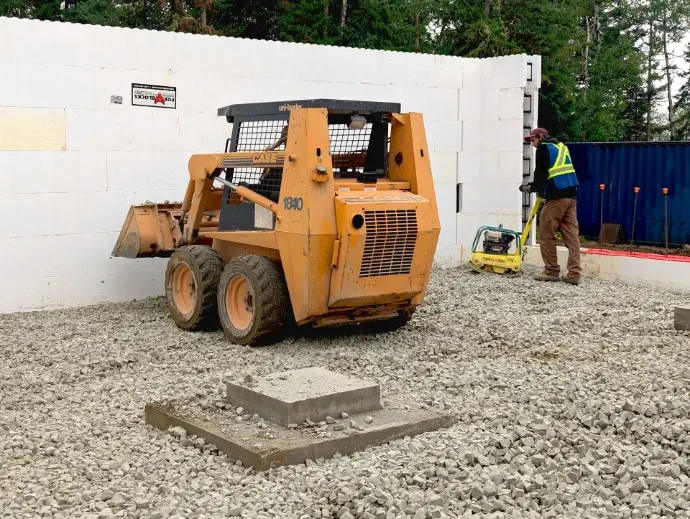
No. Jumping jacks are not recommended; use a plate compactor in 150 to 300 mm loose lifts, with more passes rather than more vibration.[11]
Sources
- [1] Enviro-Rock applications: sub-slab, Enviro-Corp Recycling
- [2] Enviro-Rock applications: residential backfill, Enviro-Corp Recycling
- [3] Enviro-Rock civil infrastructure brochure (metric), specification table, Enviro-Corp Recycling
- [4] Enviro-Rock benefits: thermal insulation, Enviro-Corp Recycling
- [5] Field test comparing frost insulation materials in road construction, SINTEF and Norwegian Public Roads Administration
- [6] Enviro-Rock benefits: radon gas, Enviro-Corp Recycling
- [7] Alternative Backfills for Highway Applications: State of the Practice (FHWA-HRT-23-110), Federal Highway Administration, 2024
- [8] Enviro-Rock applications: swimming pools, Enviro-Corp Recycling
- [9] Enviro-Rock applications: heated driveways, Enviro-Corp Recycling
- [10] Enviro-Rock delivery trailer overview, Enviro-Corp Recycling
- [11] Enviro-Rock compaction equipment sheet, Enviro-Corp Recycling
- [12] Enviro-Rock benefits: closed-cell structure, Enviro-Corp Recycling
- [13] Enviro-Rock installation, Enviro-Corp Recycling
- [14] Frequently asked questions, Enviro-Corp Recycling
Get a price and a delivery window.
Tell us the application, the volume and where it is going. A real person replies with pricing and a delivery window.