Civil infrastructure
Lightweight trench backfill for pipes, manholes and utilities
Enviro-Rock is a lightweight, insulating and free-draining backfill for manholes and utility pipelines.[1]
- 1Road surface
- 2Foam glass aggregate trench backfill
- 3Pipe or buried utility
- 4Native soil
Light foam glass aggregate above the pipe puts less load on it and adds insulation in the trench. Schematic, not to scale.
Trench backfill
The engineering problem
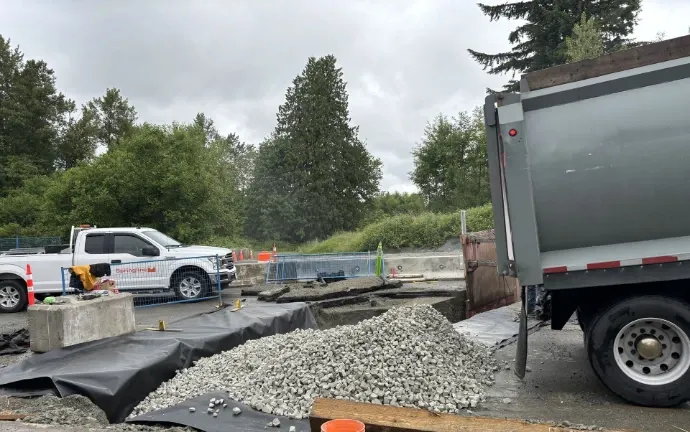
Trench backfill bears on the pipe below it for as long as the pipe is in the ground. Where a line crosses soft ground, heavy backfill also adds settlement along the trench.
Water and sewer lines also need protection from frost, which usually means burying them deeper or laying insulation over them.
Mineta Transportation Institute research found that foam glass aggregate fill reduced the maximum bending moment in culverts by 25 to 70% compared with conventional fill.[2]
Benefits
What Enviro-Rock adds
01
Less load on pipes
Enviro-Rock weighs about 200 kg/m³ (12.5 lb/ft³) loose[1], so there is far less weight above buried pipes and manholes than with conventional backfill.
On site
How it goes in
Specs that matter here
Key properties
| Property | Value |
|---|---|
| Dry bulk density | 200 kg/m³ loose (12.5 lb/ft³)[1]240 kg/m³ (15.0 lb/ft³) at 20% compaction. For design, use a moist, compacted unit weight: PennDOT practice and the Illinois Tollway design guide use 376 kg/m³ (23.5 lb/ft³) for foam glass aggregate[9], and the Kelowna design used about 2.5 kN/m³ compacted.[10] The engineer of record sets the project value. |
| Confined compressive resistance | 1.01 MPa (147 psi) at 20% deformation[1]0.56 MPa at 10% and 1.67 MPa at 30%.[1] Tested by modified EN 1097-11.[11] An index value for comparing aggregates, not an allowable bearing pressure. |
| Thermal resistance | RSI 0.42 per 25 mm (R-2.4 per inch), dry test value[1]Enviro-Rock's test reports include thermal resistivity by ASTM D5334.[11] Its thermal page gives a design value of approximately R-2 per inch.[12] Moisture in service raises the conductivity of foam glass aggregate[4], so the energy or frost designer sets the design value, and the authority having jurisdiction decides what it accepts for a loose fill. |
| Intergranular void space | 50% loose, 30% at 20% compaction[1]The brochure notes these figures are based on worldwide averages. Open-graded, so water drains through the fill and capillary rise is interrupted.[13] No permeability value is published; ask for a test if the design needs one. |
| Placement and compaction | 300 to 600 mm loose lifts under a static roller, or 150 to 300 mm under a plate compactor; compact 10 to 20%[6][7]No vibration on rollers, to prevent particle breakdown.[6] With a plate compactor, use more passes rather than more vibration, and do not use a jumping jack.[7] Allow about 20% reduction from loose thickness.[8] |
Industries
Who builds with it
Questions
Trench backfill: common questions
What is the best backfill for a utility trench?
The one the project specification calls for, chosen for loads, drainage and frost depth. Where load on the pipe, soft ground or frost is the concern, Enviro-Rock is a lightweight, insulating and free-draining option.[1]
Can Enviro-Rock be used as pipe bedding?
Enviro-Rock's guidance is that bedding, pipe-zone materials and final placement follow the project-specific design and applicable specifications.[3] Confirm with the engineer and the pipe manufacturer before placing it directly against a pipe.
Can foam glass aggregate protect water lines from freezing?
It adds insulation in the trench: Enviro-Rock is used in thermally insulating trench fill zones.[3] Layer thickness and depth of cover come from a thermal design for the site, using an in-service value because moisture raises the conductivity of foam glass aggregate.[4]
Does lightweight backfill reduce load on culverts?
Mineta Transportation Institute research found foam glass aggregate fill cut the maximum bending moment in culverts by 25 to 70% compared with conventional fill, with fill height the biggest factor.[2]
How should it be compacted in a narrow trench?
With light effort. Use a plate compactor on 150 to 300 mm loose lifts, with more passes rather than more vibration[7], and keep jumping jacks off it.[8]
What about high groundwater in the trench?
Foam glass aggregate is buoyant, so where a trench can flood, the design needs enough cover above the fill to hold it down.[5] Where the trench could carry groundwater along the line, the design may also need low-permeability plugs at intervals.
Sources
- [1] Enviro-Rock civil infrastructure brochure (metric), specification table, Enviro-Corp Recycling
- [2] The Use of Foamed Glass Aggregate (FGA) as a Lightweight Fill Above Culverts, research brief (Project 2549), 2026, Mineta Transportation Institute
- [3] Enviro-Rock applications: utilities and trench backfill, Enviro-Corp Recycling
- [4] Field test comparing frost insulation materials in road construction, SINTEF and Norwegian Public Roads Administration
- [5] Applications for Foamed Glass Lightweight Aggregate, final report with draft special provision and design guide, 2025, Illinois Tollway Research Program; Washington State University, Lafayette College and UW-Madison
- [6] Enviro-Rock installation guide, Enviro-Corp Recycling
- [7] Enviro-Rock compaction equipment sheet, Enviro-Corp Recycling
- [8] Enviro-Rock installation, Enviro-Corp Recycling
- [9] Applications for Foamed Glass Lightweight Aggregate, final report, Illinois Tollway Research Program, Washington State University et al., 2025
- [10] Case study: 6-storey building, Kelowna, Enviro-Corp Recycling
- [11] Enviro-Rock technical data, Enviro-Corp Recycling
- [12] Enviro-Rock benefits: thermal insulation, Enviro-Corp Recycling
- [13] Enviro-Rock benefits: drainage and permeability, Enviro-Corp Recycling
Get a price and a delivery window.
Tell us the application, the volume and where it is going. A real person replies with pricing and a delivery window.