Buildings
Under-slab insulation that also drains and vents soil gas
Enviro-Rock can provide drainage, insulation and radon venting space in one aggregate layer under the slab, in place of separate drain rock and rigid foam.[1]
- 1Concrete slab on grade
- 2Soil gas barrier, where specified
- 3Foam glass aggregate: insulation, drainage and capillary break
- 4Compacted subgrade
One compacted foam glass aggregate layer under the slab insulates, drains and breaks capillary rise. Schematic, not to scale.
Under-slab insulation
The engineering problem
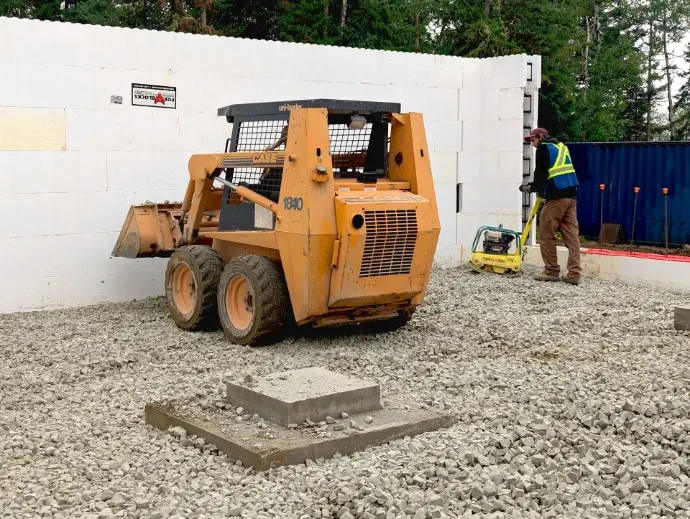
A typical slab on grade uses a layer of clear stone for drainage, capillary break and, where required, the radon gas-permeable layer, plus rigid foam board for insulation. That is two materials, two deliveries and two installation steps.
Insulation under a slab also has to carry the slab and its loads, and its value depends on moisture: water held in service raises the conductivity of foam glass aggregate[2], so the energy designer sets the design value, and the authority having jurisdiction decides what it accepts for a loose fill.
Radon control adds one more requirement: the layer under the slab has to let soil gas move to the collection pipe or depressurization system.[3]
Benefits
What Enviro-Rock adds
01
Fill and insulation in one layer
Enviro-Rock's dry test value is R-2.4 per inch[4], and its thermal page gives a design value of approximately R-2 per inch, with more thickness giving more thermal resistance.[5] The energy designer sets the value used for the project, allowing for moisture in service.[2]
On site
How it goes in
- 1
Prepare the subgrade
Proof-roll the subgrade and lay a non-woven geotextile for separation.[8]
- 2
Place and compact
Place Enviro-Rock to the thickness the energy and structural design call for, in 300 to 600 mm loose lifts under a static roller with no vibration[8], or 150 to 300 mm loose lifts under a plate compactor with more passes rather than more vibration and no jumping jack.[9] Compact 10 to 20%.[8]
- 3
Allow for compaction
Order for about a 20% reduction from loose thickness unless the design specifies otherwise.[10]
- 4
Specs that matter here
Key properties
| Property | Value |
|---|---|
| Dry bulk density | 200 kg/m³ loose (12.5 lb/ft³)[4]240 kg/m³ (15.0 lb/ft³) at 20% compaction. For design, use a moist, compacted unit weight: PennDOT practice and the Illinois Tollway design guide use 376 kg/m³ (23.5 lb/ft³) for foam glass aggregate[11], and the Kelowna design used about 2.5 kN/m³ compacted.[12] The engineer of record sets the project value. |
| Confined compressive resistance | 1.01 MPa (147 psi) at 20% deformation[4]0.56 MPa at 10% and 1.67 MPa at 30%.[4] Tested by modified EN 1097-11.[13] An index value for comparing aggregates, not an allowable bearing pressure. |
| Thermal resistance | RSI 0.42 per 25 mm (R-2.4 per inch), dry test value[4]Enviro-Rock's test reports include thermal resistivity by ASTM D5334.[13] Its thermal page gives a design value of approximately R-2 per inch.[5] Moisture in service raises the conductivity of foam glass aggregate[2], so the energy or frost designer sets the design value, and the authority having jurisdiction decides what it accepts for a loose fill. |
| Water absorption | 7.2%, uncompacted[4]A weighted average by modified ASTM C127.[14] Absorption of foam glass aggregate rises with soaking time: Indiana DOT specifies 30 to 60% by weight after 28 days.[15] Allow for in-service moisture in the design unit weight and thermal values. |
| Intergranular void space | 50% loose, 30% at 20% compaction[4]The brochure notes these figures are based on worldwide averages. Open-graded, so water drains through the fill and capillary rise is interrupted.[6] No permeability value is published; ask for a test if the design needs one. |
| Fire | Glass; does not burn[7]No fire test to a named standard, such as CAN/ULC-S114, has been published for Enviro-Rock. |
Industries
Who builds with it
Questions
Under-slab insulation: common questions
What is the best insulation to use under a concrete slab?
It depends on the R-value, the loads and what else the layer must do. Where the same layer also has to drain, break capillary rise and vent radon, one foam glass aggregate layer can replace separate drain rock and rigid foam.[1]
How thick should foam glass aggregate be under a slab?
Thickness follows from the R-value the energy design needs and the value the authority having jurisdiction accepts for a loose aggregate. Enviro-Rock's thermal page gives a design value of approximately R-2 per inch[5], but moisture in service lowers the insulating value of foam glass aggregate[2], so the envelope consultant sets the design value and the depth.
Can Enviro-Rock be the gas-permeable layer for a radon rough-in?
Gas-permeable layers for radon-control assemblies are one of its listed sub-slab uses.[16] Confirm with the designer and the building official that the layer meets your local code requirement before relying on it.
Do I still need a vapour retarder?
Enviro-Rock interrupts capillary rise[6], but it is an open-graded aggregate and does not act as a vapour retarder. Building codes normally require a soil gas barrier, usually polyethylene, under a slab on grade; Enviro-Rock does not replace it.
Does foam glass aggregate absorb water under a slab?
Some. Enviro-Rock's published absorption is 7.2% uncompacted[4]; closed internal cells limit water entering each particle while the voids between particles drain.[14] Moisture raises the conductivity of foam glass aggregate[2], so the insulation design uses an in-service value that the designer sets.
Sources
- [1] Enviro-Rock Under Slabs: Foam Glass Aggregate Explained (video), Enviro-Corp Recycling
- [2] Field test comparing frost insulation materials in road construction, SINTEF and Norwegian Public Roads Administration
- [3] Enviro-Rock benefits: radon gas, Enviro-Corp Recycling
- [4] Enviro-Rock civil infrastructure brochure (metric), specification table, Enviro-Corp Recycling
- [5] Enviro-Rock benefits: thermal insulation, Enviro-Corp Recycling
- [6] Enviro-Rock benefits: drainage and permeability, Enviro-Corp Recycling
- [7] Enviro-Rock cellular foam glass aggregate, Enviro-Corp Recycling
- [8] Enviro-Rock installation guide, Enviro-Corp Recycling
- [9] Enviro-Rock compaction equipment sheet, Enviro-Corp Recycling
- [10] Enviro-Rock installation, Enviro-Corp Recycling
- [11] Applications for Foamed Glass Lightweight Aggregate, final report, Illinois Tollway Research Program, Washington State University et al., 2025
- [12] Case study: 6-storey building, Kelowna, Enviro-Corp Recycling
- [13] Enviro-Rock technical data, Enviro-Corp Recycling
- [14] Enviro-Rock benefits: closed-cell structure, Enviro-Corp Recycling
- [15] 904-M-076 Lightweight Aggregate, Indiana DOT, 2025
- [16] Enviro-Rock applications: sub-slab, Enviro-Corp Recycling
- [17] Innovative materials for road insulation in cold climates: foam glass aggregates, 2016, Transportation Association of Canada conference paper (Laval University)
Get a price and a delivery window.
Tell us the application, the volume and where it is going. A real person replies with pricing and a delivery window.