Park boards, landscape architects and field builders
Light, free-draining fill for parks, fields and roofs
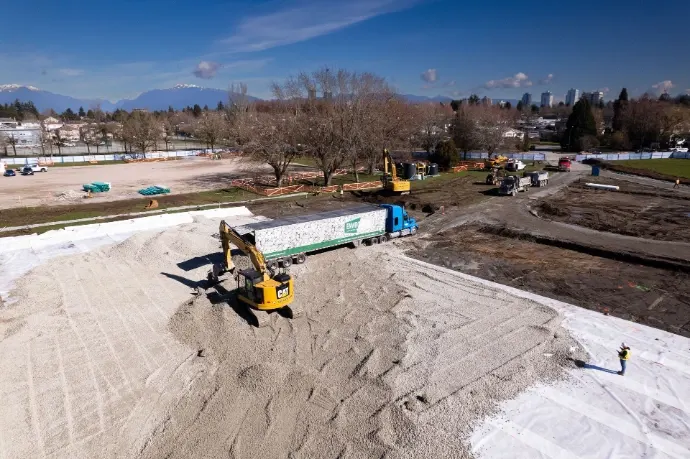
About 11,000 m³ of Enviro-Rock went under the Killarney Park soccer field in Vancouver, with a drainage network trenched into the fill.[1] In Burnaby, a 500 mm layer brought the Jim Lorimer Park playground to grade over soft wetland soils.[2]
Challenges
Common site problems
01
Soft, wet ground
Raising a park or field over soft ground adds load that drives settlement. At Jim Lorimer Park in Burnaby, the soils were soft wetland soils and the site floods seasonally.[2]
02
Water under the playing surface
A sports field needs a base that moves water away from the turf quickly, under natural grass or synthetic turf.
03
Load limits over structure
Green roofs, plazas and elevated patios must meet strict structural load limits.[3]
Where Enviro-Rock fits
How Enviro-Rock helps
01
Less settlement on soft ground
At Jim Lorimer Park, the design with lighter fill projects roughly 200 mm of settlement instead of around 600 mm, with 20 to 30 mm of movement expected within the reinforced layer.[2]
02
Drainage built into the fill
At Killarney Park, a perforated drainage network was trenched directly into the fill and separated by geotextile from the base aggregate, sand and grass above.[1] Enviro-Rock's brochure gives 50% void space loose and 30% at 20% compaction, based on worldwide averages.[4]
03
Held down where water rises
Foam glass aggregate is buoyant. At Jim Lorimer Park, the design anchored the fill against uplift, reinforced it with dual geogrid and installed settlement gauges to monitor the ground.[2]
04
Light fill over structure
Enviro-Rock is used in green roof build-ups, beneath pavers and pedestal systems and in deep-fill rooftop assemblies.[5] It weighs 200 kg/m³ (12.5 lb/ft³) loose.[4]
05
Grass, turf and play areas
It is used under natural grass sports fields, synthetic turf fields, playgrounds and public parks.[6]
Applications
Used most in landscape and recreation
Application
Soft ground embankments
Enviro-Rock foam glass aggregate fill for road embankments, grade raises and widenings over soft or compressible ground, accepted on BC's Recognized Products List.
Application
Retaining wall backfill
Free-draining foam glass aggregate backfill for MSE, cast-in-place and segmental retaining walls, where a lighter fill means less lateral earth pressure on the wall.
Application
Green roof and plaza fill
Lightweight, free-draining foam glass aggregate for green roof build-ups, deep fill over roof slabs and the base under pavers and pedestals on plazas and terraces.
Application
Sports field fill
Lightweight, free-draining fill that brings sports fields, parks and playgrounds to grade over soft ground, used at Vancouver's Killarney Park and Burnaby's Jim Lorimer Park.
Questions
Common questions
How much Enviro-Rock went under Killarney Park?
About 11,000 m³, supplied as the lightweight fill beneath the soccer field.[1]
What goes between the fill and the turf?
That follows the field design. At Killarney Park, geotextile separated the fill from a permeable base aggregate, the field sand and natural grass turf.[1]
Will the fill float on a site that floods?
Foam glass aggregate is buoyant, so specifications place it above the water table or hold it down with cover material.[7] At Jim Lorimer Park, which floods seasonally, the design anchored the fill against uplift.[2]
Sources
- [1] Case study: Killarney Park soccer field, Vancouver, Enviro-Corp Recycling
- [2] Case study: Jim Lorimer Park playground, Burnaby, Enviro-Corp Recycling
- [3] Enviro-Rock building construction brochure (metric), Enviro-Corp Recycling
- [4] Enviro-Rock civil infrastructure brochure (metric), specification table, Enviro-Corp Recycling
- [5] Enviro-Rock applications: green roofs and terraces, Enviro-Corp Recycling
- [6] Enviro-Rock applications: sports fields and recreational areas, Enviro-Corp Recycling
- [7] Applications for Foamed Glass Lightweight Aggregate, final report, Illinois Tollway Research Program, Washington State University et al., 2025
- [8] Enviro-Rock delivery trailer overview, Enviro-Corp Recycling
Get a price and a delivery window.
Tell us the application, the volume and where it is going. A real person replies with pricing and a delivery window.