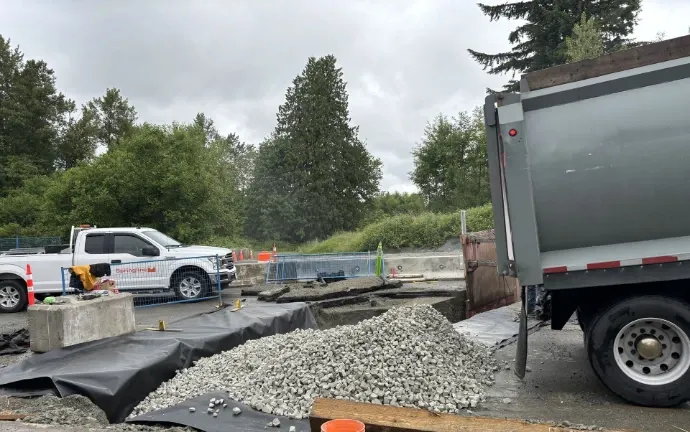
Challenges
Common site problems
01
Soft ground under parks and roads
Raising a park, playground or road over soft, wet ground adds load that drives settlement. At Jim Lorimer Park in Burnaby, settlement on soft wetland soils was projected at around 600 mm before the fill load was reduced.[2]
02
Load on buried pipes and structures
Fill over pipes, culverts, manholes and buried tanks adds load to structures that are costly to dig up and repair.
03
Getting a newer material specified
A consultant has to write a material into the contract and defend it to the reviewer. At Killarney Park in Vancouver, the original specification called for pumice, and Enviro-Rock had to be accepted as an approved equal.[3]
Where Enviro-Rock fits
How Enviro-Rock helps
01
Less settlement on soft ground
At Jim Lorimer Park, a 500 mm layer of Enviro-Rock brought the site to grade, and the design projects roughly 200 mm of settlement instead of around 600 mm.[2]
02
Less load on buried structures
A Mineta Transportation Institute modelling study found foam glass aggregate fill reduced the maximum bending moment in culverts by 25 to 70% compared with conventional fill.[4] Enviro-Rock is used as a light, insulating and free-draining backfill for manholes and utility pipelines.[1]
03
Accepted as an approved equal
About 11,000 m³ went under the Killarney Park soccer field in Vancouver in place of the originally specified pumice.[3]
04
Made from glass collected in BC
Enviro-Rock is 100% recycled glass, made in Canada from glass collected throughout BC.[5][1]
05
Trench details follow your design
Enviro-Rock goes into utility trenches, pipeline corridors and insulating trench fill zones, with bedding and pipe-zone materials set by the project design and specifications.[6]
06
Accepted for provincial work
Enviro-Rock is an accepted lightweight fill product on the BC Ministry of Transportation and Transit Recognized Products List.[7]
Applications
Used most in municipal works
Application
Soft ground embankments
Enviro-Rock foam glass aggregate fill for road embankments, grade raises and widenings over soft or compressible ground, accepted on BC's Recognized Products List.
Application
Retaining wall backfill
Free-draining foam glass aggregate backfill for MSE, cast-in-place and segmental retaining walls, where a lighter fill means less lateral earth pressure on the wall.
Application
Trench backfill
Lightweight, insulating trench backfill for utility lines, pipeline corridors and manholes, to cut the load on buried pipes and help protect lines from frost.
Application
Sports field fill
Lightweight, free-draining fill that brings sports fields, parks and playgrounds to grade over soft ground, used at Vancouver's Killarney Park and Burnaby's Jim Lorimer Park.
Application
Frost protection
An insulating, non-frost-susceptible foam glass aggregate layer that reduces frost penetration into susceptible subgrades under roads, pavements and foundations in cold regions.
Questions
Common questions
Which municipal projects have used Enviro-Rock?
Published projects include the Jim Lorimer Park playground in Burnaby and the Killarney Park soccer field in Vancouver, both designed by Van der Zalm + Associates.[2][3]
Is there MMCD specification text for Enviro-Rock?
Enviro-Rock does not publish an MMCD-format section. Consultants specify it in the project documents from the published property table[1], and test reports are available on request.[8]
Can Enviro-Rock be used as utility trench backfill?
Yes. It is used for utility trench backfill, pipeline corridors and insulating trench fill zones, and bedding and pipe-zone materials follow the project design.[6]
Will the fill float on a wet park site?
Foam glass aggregate is buoyant, so specifications place it above the water table or hold it down with cover material.[9] At Jim Lorimer Park, where the site floods seasonally, the design anchored the fill against uplift.[2]
Sources
- [1] Enviro-Rock civil infrastructure brochure (metric), specification table, Enviro-Corp Recycling
- [2] Case study: Jim Lorimer Park playground, Burnaby, Enviro-Corp Recycling
- [3] Case study: Killarney Park soccer field, Vancouver, Enviro-Corp Recycling
- [4] The Use of Foamed Glass Aggregate (FGA) as a Lightweight Fill Above Culverts, research brief (Project 2549), 2026, Mineta Transportation Institute
- [5] Enviro-Rock cellular foam glass aggregate, Enviro-Corp Recycling
- [6] Enviro-Rock applications: utilities and trench backfill, Enviro-Corp Recycling
- [7] Recognized Products List, Lightweight Fill Material (October 1, 2026), BC Ministry of Transportation and Transit
- [8] Enviro-Rock technical data, Enviro-Corp Recycling
- [9] Applications for Foamed Glass Lightweight Aggregate, final report, Illinois Tollway Research Program, Washington State University et al., 2025
- [10] Enviro-Rock benefits: chemical resistance, Enviro-Corp Recycling
- [11] Alternative Backfills for Highway Applications: State of the Practice (FHWA-HRT-23-110), Federal Highway Administration, 2024
- [12] Enviro-Rock delivery trailer overview, Enviro-Corp Recycling
Get a price and a delivery window.
Tell us the application, the volume and where it is going. A real person replies with pricing and a delivery window.