Residential
Lightweight backfill for basements, pools and heated driveways
Enviro-Rock is used as backfill around basement and foundation walls[1], beneath and around swimming pools[2], and under heated driveways and snow-melt slabs.[3]
- 1Wall, abutment or foundation wall
- 2Foam glass aggregate backfill
- 3Lower lateral pressure on the wall
- 4Free-draining fill and drain
- 5Native soil
Light, free-draining foam glass aggregate against the foundation wall lowers the pressure on it and carries water down to the drain. Schematic, not to scale.
Basements, pools and driveways
The engineering problem
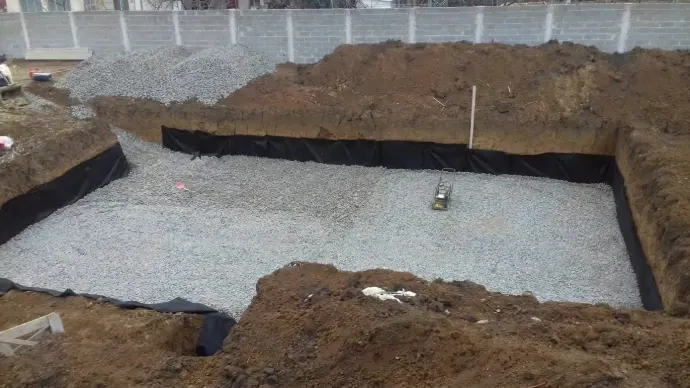
Basement walls hold back the soil and any water trapped in it. Backfill that drains poorly lets water build up against the wall, and heavy, wet backfill adds pressure the wall has to resist.
Pools and hot tubs lose heat through their walls and floor, and heated driveways and snow-melt slabs lose heat downward into cold ground unless something insulates below them.
On deep residential excavations and additions, a conventional build uses several materials: drain rock against the wall, board insulation and imported fill. Each one is another delivery and another step.
Benefits
What Enviro-Rock adds
01
Less pressure on walls
FHWA states that the low weight and high friction angle of foam glass aggregate can reduce vertical and lateral forces by more than one-half.[4] Enviro-Rock weighs about 200 kg/m³ (12.5 lb/ft³) loose.[5]
02
Water drains away from the wall
Interconnected voids let water drain through the backfill to the footing drain rather than becoming trapped against the foundation.[6]
On site
How it goes in
- 1
Order the right load
Trailer loads run from about 45 m³ up to 140 m³, and super sacks hold 1.7 m³ each.[9] No minimum order is published, so ask when you request a quote.
- 2
Separate from native soil
Lay non-woven geotextile against the native soil so fines stay out of the backfill.[10]
- 3
Place and compact
Compact with a plate compactor on 150 to 300 mm loose lifts, using more passes rather than more vibration, and never a jumping jack.[11]
- 4
Finish the surface
Cover with geotextile and a low-permeability cap graded away from the wall, or with the crushed gravel base and concrete for a driveway or patio.[10]
Specs that matter here
Key properties
| Property | Value |
|---|---|
| Dry bulk density | 200 kg/m³ loose (12.5 lb/ft³)[5]240 kg/m³ (15.0 lb/ft³) at 20% compaction. For design, use a moist, compacted unit weight: PennDOT practice and the Illinois Tollway design guide use 376 kg/m³ (23.5 lb/ft³) for foam glass aggregate[12], and the Kelowna design used about 2.5 kN/m³ compacted.[13] The engineer of record sets the project value. |
| Thermal resistance | RSI 0.42 per 25 mm (R-2.4 per inch), dry test value[5]Enviro-Rock's test reports include thermal resistivity by ASTM D5334.[14] Its thermal page gives a design value of approximately R-2 per inch.[7] Moisture in service raises the conductivity of foam glass aggregate[8], so the energy or frost designer sets the design value, and the authority having jurisdiction decides what it accepts for a loose fill. |
| Intergranular void space | 50% loose, 30% at 20% compaction[5]The brochure notes these figures are based on worldwide averages. Open-graded, so water drains through the fill and capillary rise is interrupted.[6] No permeability value is published; ask for a test if the design needs one. |
| Placement and compaction | 300 to 600 mm loose lifts under a static roller, or 150 to 300 mm under a plate compactor; compact 10 to 20%[10][11]No vibration on rollers, to prevent particle breakdown.[10] With a plate compactor, use more passes rather than more vibration, and do not use a jumping jack.[11] Allow about 20% reduction from loose thickness.[15] |
| Recycled content | 100% recycled glass[16] |
Industries
Who builds with it
Questions
Basements, pools and driveways: common questions
What is the best backfill material for a foundation?
A free-draining granular fill that keeps water off the wall. Enviro-Rock drains freely[6] and adds insulation around the foundation.[7]
Can lightweight backfill reduce pressure on basement walls?
Yes, if the light backfill fills the wedge of soil that pushes on the wall.[17] FHWA states that foam glass aggregate can reduce lateral forces by more than one-half[4]; the wall design still sets the drainage, reinforcement and final values.
What is the best backfill for an inground pool?
Follow the pool manufacturer's and engineer's requirements. Enviro-Rock is used beneath pool foundations, as backfill around pool walls and shells, and around hot tubs and other heated water structures.[2]
Do heated driveways need insulation underneath?
Insulation below a heated slab cuts the heat lost into the ground. Enviro-Rock is used under heated driveways, snow-melt pavements, heated walkways and patios.[3]
Can I get a small amount for one house?
Super sacks hold 1.7 m³ each, and the smallest trailer loads are about 45 m³.[9] No minimum order is published, so ask when you request a quote with your volume and address. Pickup from the Quesnel facility is available by appointment.[18]
Will the backfill float if groundwater rises?
Foam glass aggregate is buoyant, so the backfill needs working drainage, and the design must check uplift wherever groundwater can rise into it.[17]
Sources
- [1] Enviro-Rock applications: residential backfill, Enviro-Corp Recycling
- [2] Enviro-Rock applications: swimming pools, Enviro-Corp Recycling
- [3] Enviro-Rock applications: heated driveways, Enviro-Corp Recycling
- [4] Alternative Backfills for Highway Applications: State of the Practice (FHWA-HRT-23-110), 2024, Federal Highway Administration, Turner-Fairbank Highway Research Center
- [5] Enviro-Rock civil infrastructure brochure (metric), specification table, Enviro-Corp Recycling
- [6] Enviro-Rock benefits: drainage and permeability, Enviro-Corp Recycling
- [7] Enviro-Rock benefits: thermal insulation, Enviro-Corp Recycling
- [8] Field test comparing frost insulation materials in road construction, SINTEF and Norwegian Public Roads Administration
- [9] Enviro-Rock delivery trailer overview, Enviro-Corp Recycling
- [10] Enviro-Rock installation guide, Enviro-Corp Recycling
- [11] Enviro-Rock compaction equipment sheet, Enviro-Corp Recycling
- [12] Applications for Foamed Glass Lightweight Aggregate, final report, Illinois Tollway Research Program, Washington State University et al., 2025
- [13] Case study: 6-storey building, Kelowna, Enviro-Corp Recycling
- [14] Enviro-Rock technical data, Enviro-Corp Recycling
- [15] Enviro-Rock installation, Enviro-Corp Recycling
- [16] Enviro-Rock cellular foam glass aggregate, Enviro-Corp Recycling
- [17] Applications for Foamed Glass Lightweight Aggregate, final report with draft special provision and design guide, 2025, Illinois Tollway Research Program; Washington State University, Lafayette College and UW-Madison
- [18] Frequently asked questions, Enviro-Corp Recycling
Get a price and a delivery window.
Tell us the application, the volume and where it is going. A real person replies with pricing and a delivery window.