Parks and recreation
Lightweight fill under sports fields, parks and playgrounds
About 11,000 m³ of Enviro-Rock went in beneath the Killarney Park soccer field in Vancouver, in place of the originally specified pumice.[1]
- 1Turf and sand root zone
- 2Permeable base aggregate
- 3Foam glass aggregate fill
- 4Drainage pipe trenched into the fill
- 5Soft ground below
Foam glass aggregate fill with drains trenched into it carries the base, sand and turf over soft ground. Schematic, not to scale.
Sports field fill
The engineering problem
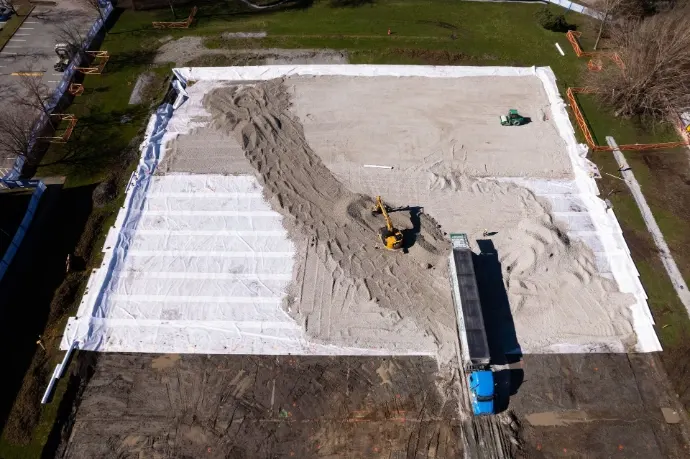
Raising a field or playground to grade over soft ground adds load, and the ground settles under it. Without a lighter fill, settlement at Jim Lorimer Park in Burnaby was projected at around 600 mm.[2]
Fields also have to drain quickly after rain, and some park sites flood. A heavy, slow-draining base works against both.
Killarney Park's design originally specified pumice.[1] Caltrans lists natural volcanic lightweight material, the group pumice belongs to, at about 800 to 1,200 kg/m³ (50 to 75 lb/ft³)[3], two or more times the 160 to 400 kg/m³ (10 to 25 lb/ft³) FHWA gives for foam glass aggregate.[4]
Benefits
What Enviro-Rock adds
01
Less settlement over soft ground
At Jim Lorimer Park, the design with a 500 mm Enviro-Rock layer projects settlement of roughly 200 mm, down from around 600 mm, with 20 to 30 mm of movement expected within the reinforced layer itself.[2]
02
A drainage layer under the turf
At Killarney Park, a perforated drainage network was trenched into the lightweight fill and separated by geotextile from the permeable base aggregate, field sand and natural grass above.[1]
On site
How it goes in
- 1
- 2
- 3
Trench in the drains
Cut the perforated drainage network into the fill, as at Killarney Park, then separate it from the base aggregate above with geotextile.[1]
- 4
Anchor where it can flood
On flood-prone sites, anchor or ballast the fill against uplift. Jim Lorimer Park's design anchored the buoyant aggregate because the site floods seasonally, and settlement gauges monitor the ground.[2]
Specs that matter here
Key properties
| Property | Value |
|---|---|
| Dry bulk density | 200 kg/m³ loose (12.5 lb/ft³)[7]240 kg/m³ (15.0 lb/ft³) at 20% compaction. For design, use a moist, compacted unit weight: PennDOT practice and the Illinois Tollway design guide use 376 kg/m³ (23.5 lb/ft³) for foam glass aggregate[8], and the Kelowna design used about 2.5 kN/m³ compacted.[9] The engineer of record sets the project value. |
| Confined compressive resistance | 1.01 MPa (147 psi) at 20% deformation[7]0.56 MPa at 10% and 1.67 MPa at 30%.[7] Tested by modified EN 1097-11.[10] An index value for comparing aggregates, not an allowable bearing pressure. |
| Intergranular void space | 50% loose, 30% at 20% compaction[7]The brochure notes these figures are based on worldwide averages. Open-graded, so water drains through the fill and capillary rise is interrupted.[11] No permeability value is published; ask for a test if the design needs one. |
| Placement and compaction | 300 to 600 mm loose lifts under a static roller, or 150 to 300 mm under a plate compactor; compact 10 to 20%[5][6]No vibration on rollers, to prevent particle breakdown.[5] With a plate compactor, use more passes rather than more vibration, and do not use a jumping jack.[6] Allow about 20% reduction from loose thickness.[12] |
| Recycled content | 100% recycled glass[13] |
Industries
Who builds with it
Questions
Sports field fill: common questions
What base goes under artificial turf?
A free-draining granular base set by the turf system and the field designer. Over soft ground, Enviro-Rock can sit below the base layers as lightweight fill; synthetic turf fields are one of its listed uses.[14]
How much Enviro-Rock went under Killarney Park?
Around 11,000 m³, giving the field a stable, free-draining foundation made from 100% recycled glass.[1]
Can a sports field be built over soft ground?
Yes, with fill light enough to limit the new load. At Jim Lorimer Park, the design with a 500 mm Enviro-Rock layer projects roughly 200 mm of settlement instead of around 600 mm.[2]
Will the fill float if the park floods?
Foam glass aggregate is buoyant, so flood-prone sites need anchoring or ballast. Jim Lorimer Park's design anchored the Enviro-Rock layer against uplift because the site floods seasonally.[2]
How does foam glass aggregate compare with pumice?
Caltrans lists natural volcanic lightweight material, which includes pumice, at about 800 to 1,200 kg/m³ (50 to 75 lb/ft³)[3], against an FHWA range of 160 to 400 kg/m³ (10 to 25 lb/ft³) for foam glass aggregate.[4] At Killarney Park, Enviro-Rock went in where the design first specified pumice.[1]
Sources
- [1] Case study: Killarney Park soccer field, Vancouver, Enviro-Corp Recycling
- [2] Case study: Jim Lorimer Park playground, Burnaby, Enviro-Corp Recycling
- [3] Geotechnical Manual: Ground Modification, January 2026, California Department of Transportation
- [4] Alternative Backfills for Highway Applications: State of the Practice (FHWA-HRT-23-110), 2024, Federal Highway Administration, Turner-Fairbank Highway Research Center
- [5] Enviro-Rock installation guide, Enviro-Corp Recycling
- [6] Enviro-Rock compaction equipment sheet, Enviro-Corp Recycling
- [7] Enviro-Rock civil infrastructure brochure (metric), specification table, Enviro-Corp Recycling
- [8] Applications for Foamed Glass Lightweight Aggregate, final report, Illinois Tollway Research Program, Washington State University et al., 2025
- [9] Case study: 6-storey building, Kelowna, Enviro-Corp Recycling
- [10] Enviro-Rock technical data, Enviro-Corp Recycling
- [11] Enviro-Rock benefits: drainage and permeability, Enviro-Corp Recycling
- [12] Enviro-Rock installation, Enviro-Corp Recycling
- [13] Enviro-Rock cellular foam glass aggregate, Enviro-Corp Recycling
- [14] Enviro-Rock applications: sports fields and recreational areas, Enviro-Corp Recycling
Get a price and a delivery window.
Tell us the application, the volume and where it is going. A real person replies with pricing and a delivery window.