Civil infrastructure
Lightweight subgrade fill below ballast for rail on soft ground
Enviro-Rock can go below conventional ballast and granular track layers as a lightweight fill zone, with geotextile separation as the project design requires.[1]
- 1Track and ties
- 2Ballast and granular track layers
- 3Foam glass aggregate subgrade fill, separated by geotextile
- 4Soft or compressible ground
A foam glass aggregate zone under the ballast and granular layers lightens the load on the soft ground below the track. Schematic, not to scale.
Railbed fill
The engineering problem
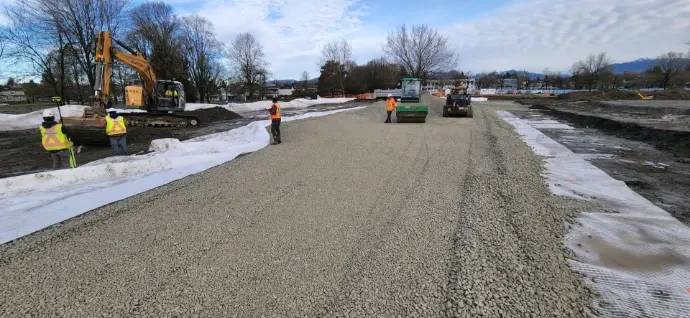
Track geometry depends on the subgrade below it. Where rail crosses soft ground, the weight of the embankment and track structure drives settlement that has to be corrected over time.
Approaches to bridges and other structures are the hardest spots, because the structure holds its level while the embankment beside it settles.
In rail yards and urban corridors, space and track time limit how much heavy fill can be trucked in and how long the ground can be left to consolidate.
Benefits
What Enviro-Rock adds
01
Less load on the subgrade
Enviro-Rock weighs about 200 kg/m³ (12.5 lb/ft³) loose[2], so the fill below the track adds far less load to soft ground than conventional fill.
02
Repeated-load data from highway research
Illinois Tollway testing found no loss of resilient modulus in two foam glass aggregate products over 560,000 load cycles.[3] A rail line sees far more load cycles, so the rail designer checks the stress reaching the fill.
03
Drains below the ballast
Its open-graded structure lets water drain through the fill rather than become trapped under the track.[4]
On site
How it goes in
- 1
Design the fill zone
The rail designer sets the depth of the lightweight zone and of the ballast and granular layers above it.[1]
- 2
Separate
Lay non-woven geotextile on the proof-rolled subgrade, and between the fill and the granular track layers where the design requires.[5]
- 3
- 4
Build the track structure
Place the granular layers and ballast above, keeping wheeled machines off the exposed fill.[7]
Specs that matter here
Key properties
| Property | Value |
|---|---|
| Dry bulk density | 200 kg/m³ loose (12.5 lb/ft³)[2]240 kg/m³ (15.0 lb/ft³) at 20% compaction. For design, use a moist, compacted unit weight: PennDOT practice and the Illinois Tollway design guide use 376 kg/m³ (23.5 lb/ft³) for foam glass aggregate[8], and the Kelowna design used about 2.5 kN/m³ compacted.[9] The engineer of record sets the project value. |
| Confined compressive resistance | 1.01 MPa (147 psi) at 20% deformation[2]0.56 MPa at 10% and 1.67 MPa at 30%.[2] Tested by modified EN 1097-11.[10] An index value for comparing aggregates, not an allowable bearing pressure. |
| Angle of friction | 39° at 65 kPa normal stress[2]The friction angle of foam glass aggregate falls as normal stress rises[8], so the geotechnical engineer selects the design value for the stress on the project from test data and design conditions.[11] |
| Freeze-thaw loss | 4.0% weighted loss (CSA A23.2-24A, unconfined)[2]The test's reference aggregate lost 14.2%, within the 8.5 to 15.3% limits the method sets for it, which shows the test run was valid. It is a calibration check, not a comparison with ordinary aggregate.[2] |
| Intergranular void space | 50% loose, 30% at 20% compaction[2]The brochure notes these figures are based on worldwide averages. Open-graded, so water drains through the fill and capillary rise is interrupted.[4] No permeability value is published; ask for a test if the design needs one. |
| Placement and compaction | 300 to 600 mm loose lifts under a static roller, or 150 to 300 mm under a plate compactor; compact 10 to 20%[5][6]No vibration on rollers, to prevent particle breakdown.[5] With a plate compactor, use more passes rather than more vibration, and do not use a jumping jack.[6] Allow about 20% reduction from loose thickness.[7] |
Industries
Who builds with it
Questions
Railbed fill: common questions
Can foam glass aggregate be used under rail track?
Yes, below the ballast and granular track layers as a lightweight fill zone, with geotextile separation as the project design requires.[1]
Where does lightweight fill help most on a railway?
On soft or compressible ground, at track approaches near bridges and structures, and in rail yards and constrained urban corridors.[1]
How does it handle repeated train loads?
The closest published data comes from highway research: Illinois Tollway testing found no loss of resilient modulus in two foam glass aggregate products over 560,000 load cycles.[3] Design guidance also limits the stress reaching the top of the foam glass layer, which sets how much cover goes above it.[3]
Does it need to stay above the water table?
Foam glass aggregate is buoyant, so designs keep it above the water table and design flood level or hold it down with the weight above it.[3]
Which approvals apply to rail projects?
Enviro-Rock is an accepted lightweight fill on the BC Ministry of Transportation and Transit Recognized Products List, which covers Ministry projects.[12] Railway owners set their own material requirements, so acceptance on each project rests with the railway owner and the engineer of record.
Sources
- [1] Enviro-Rock applications: railways and railbeds, Enviro-Corp Recycling
- [2] Enviro-Rock civil infrastructure brochure (metric), specification table, Enviro-Corp Recycling
- [3] Applications for Foamed Glass Lightweight Aggregate, final report with draft special provision and design guide, 2025, Illinois Tollway Research Program; Washington State University, Lafayette College and UW-Madison
- [4] Enviro-Rock benefits: drainage and permeability, Enviro-Corp Recycling
- [5] Enviro-Rock installation guide, Enviro-Corp Recycling
- [6] Enviro-Rock compaction equipment sheet, Enviro-Corp Recycling
- [7] Enviro-Rock installation, Enviro-Corp Recycling
- [8] Applications for Foamed Glass Lightweight Aggregate, final report, Illinois Tollway Research Program, Washington State University et al., 2025
- [9] Case study: 6-storey building, Kelowna, Enviro-Corp Recycling
- [10] Enviro-Rock technical data, Enviro-Corp Recycling
- [11] Enviro-Rock benefits: angle of friction, Enviro-Corp Recycling
- [12] Recognized Products List, Lightweight Fill Material (October 1, 2026), BC Ministry of Transportation and Transit
Get a price and a delivery window.
Tell us the application, the volume and where it is going. A real person replies with pricing and a delivery window.