Communities, highway agencies, mines and camps
Frost protection for cold-region roads and buildings
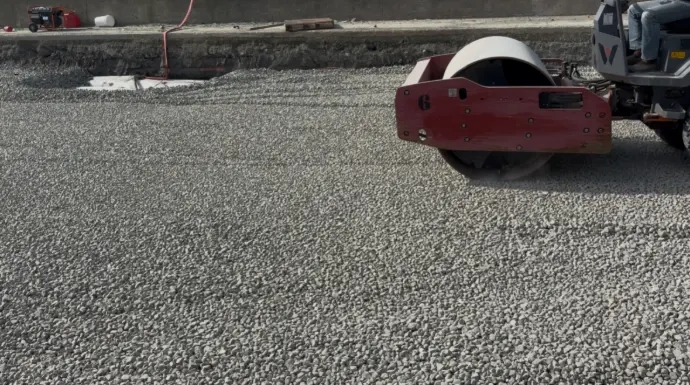
Enviro-Rock is a non-frost-susceptible aggregate without the fine soil matrix that contributes to frost heave.[1] It adds insulation as it fills[2], and it ships in trailer loads of up to 140 m³ (about 183 yd³).[3]
Challenges
Common site problems
01
Frost heave
Frost-susceptible soils heave in winter and settle in spring under roads, slabs and shallow utilities.
02
Freight to remote sites
Shipping distance significantly affects the cost of foam glass aggregate[4], so on a remote project the number of truckloads matters.
03
No listing in the Yukon or Alaska
Enviro-Rock is not on a Yukon or Alaska product list, so acceptance on those projects rests with the project owner and the engineer of record, based on the test data submitted.
Where Enviro-Rock fits
How Enviro-Rock helps
01
Non-frost-susceptible fill
Enviro-Rock provides a non-frost-susceptible aggregate layer for cold-climate and below-grade work.[1]
02
Stands up to freeze-thaw
In the CSA A23.2-24A unconfined freeze-thaw test, Enviro-Rock had a 4.0% weighted loss. The test's reference aggregate lost 14.2%, inside the range that shows the run was valid.[5]
03
Insulation in the fill layer
Enviro-Rock's dry test value is R-2.4 per inch[5], and its thermal page gives a design value of approximately R-2 per inch.[2] For frost design, moisture in service raises the conductivity of foam glass aggregate, so the frost designer sets an in-service value.[6]
04
Used as road insulation in Nordic practice
A Norwegian Public Roads Administration field study names foam glass aggregate as one of three products used regularly in Norway as road thermal insulation.[6] In the first, mild winter of a Quebec field trial, a 150 mm foam glass aggregate layer insulated a pavement about as well as 50 mm of extruded polystyrene board.[7]
05
Light loads for long hauls
Lightweight fills are usually limited by how much volume a truck holds rather than how much weight it can carry.[8] Enviro-Rock moves in B-train loads of up to 140 m³ (about 183 yd³), and pickup from the Quesnel facility is available by appointment.[3][9]
06
Accepted for BC highway work
Enviro-Rock is an accepted lightweight fill product on the BC Ministry of Transportation and Transit Recognized Products List.[10]
Applications
Used most in northern and cold regions
Application
Soft ground embankments
Enviro-Rock foam glass aggregate fill for road embankments, grade raises and widenings over soft or compressible ground, accepted on BC's Recognized Products List.
Application
Under-slab insulation
One layer of foam glass aggregate under a slab on grade that insulates, drains, breaks capillary rise and gives soil gas a path to a radon system.
Application
Trench backfill
Lightweight, insulating trench backfill for utility lines, pipeline corridors and manholes, to cut the load on buried pipes and help protect lines from frost.
Application
Frost protection
An insulating, non-frost-susceptible foam glass aggregate layer that reduces frost penetration into susceptible subgrades under roads, pavements and foundations in cold regions.
Questions
Common questions
Where does Enviro-Rock deliver?
Enviro-Rock's published delivery area is British Columbia, Alberta, Washington, Oregon and California.[9] For a site outside that area, such as in the Yukon or Alaska, ask when you request a quote.
Is Enviro-Rock approved in the Yukon or Alaska?
No. Enviro-Rock is not on a Yukon or Alaska product list, so acceptance there rests with the project owner and the engineer of record. In BC it is an accepted lightweight fill on the Ministry of Transportation and Transit Recognized Products List.[10]
How thick does a frost insulation layer need to be?
The engineer of record sets it from the climate, the soil and the structure. In its first, mild winter, a Quebec field trial matched 50 mm of extruded polystyrene with 150 mm of foam glass aggregate.[7] Under Norway's current guidelines an insulated structure for a new E6 section needed 202 cm, and NTNU's numerical analysis suggests 132 cm, including 60 cm of foam glass or lightweight aggregate insulation, might be enough.[11]
Does moisture reduce the insulation value?
Yes, for foam glass aggregate as a class. A Norwegian road study measured about 0.155 W/(m·K) at the roughly 20% moisture content found in service, higher than dry laboratory values.[6] The frost designer sets the in-service design value; ask for Enviro-Rock's thermal test report to see the method behind its dry figure.[12]
Can it be used over permafrost?
No permafrost project using Enviro-Rock has been published. Its published frost data is a freeze-thaw durability test and its thermal values[5], so a permafrost design needs a site-specific thermal analysis by the engineer of record.
Does freight make it too expensive for remote sites?
Shipping distance significantly affects the cost: in Illinois Tollway research, an 800-mile haul added about $34 to an in-place cubic yard of foam glass aggregate costing $169.[4] Because it is light, a B-train carries up to 140 m³ (about 183 yd³) of Enviro-Rock, so each load moves a large volume of fill.[3]
Sources
- [1] Enviro-Rock benefits: frost resistance, Enviro-Corp Recycling
- [2] Enviro-Rock benefits: thermal insulation, Enviro-Corp Recycling
- [3] Enviro-Rock delivery trailer overview, Enviro-Corp Recycling
- [4] Applications for Foamed Glass Lightweight Aggregate, final report, Illinois Tollway Research Program, Washington State University et al., 2025
- [5] Enviro-Rock civil infrastructure brochure (metric), specification table, Enviro-Corp Recycling
- [6] Field test comparing frost insulation materials in road construction, SINTEF and Norwegian Public Roads Administration
- [7] Innovative materials for road insulation in cold climates: foam glass aggregates, Transportation Association of Canada, 2016
- [8] Guidelines for Using Lightweight Fills in Transportation Infrastructure Applications, Texas DOT and University of Texas at Austin, 2025
- [9] Frequently asked questions, Enviro-Corp Recycling
- [10] Recognized Products List, Lightweight Fill Material (October 1, 2026), BC Ministry of Transportation and Transit
- [11] Design of roads using frost insulation materials: case study new E6 in Hedmark, Norway, 2019, Norwegian University of Science and Technology (NTNU)
- [12] Enviro-Rock technical data, Enviro-Corp Recycling
Get a price and a delivery window.
Tell us the application, the volume and where it is going. A real person replies with pricing and a delivery window.