Developers, general contractors and design teams
Foam glass aggregate for building projects
On a six-storey building in Kelowna, the design sub-excavates 1.8 m of soil and backfills with 1.2 m of foam glass aggregate to top of footing, with mineral aggregate above, for expected settlement under 25 mm over 50 years, down from a projected 85 to 115 mm without ground improvement. Enviro-Rock is named as the basis of design.[1]
Challenges
Common site problems
01
Settlement on clay
A mid-rise building can settle more than its structure tolerates. In Kelowna, a six-storey building faced a projected 85 to 115 mm of settlement without ground improvement.[1]
02
Dead load over structure
Every layer above a podium or roof slab is dead load the structure carries. Elevated patios and green roofs come with strict structural load limits.[2]
03
Separate layers under the slab
A slab on grade typically takes a clear stone layer for drainage, capillary break and, where required, radon venting, plus rigid foam board for insulation: two materials, each with its own detailing, crew and inspection.
Where Enviro-Rock fits
How Enviro-Rock helps
01
Load-compensating fill
Taking out heavy soil and putting back light fill means the building adds much less net load to the clay. The Kelowna design that does this was independently peer reviewed, with every comment resolved and accepted before tender.[1]
02
Carries footing loads
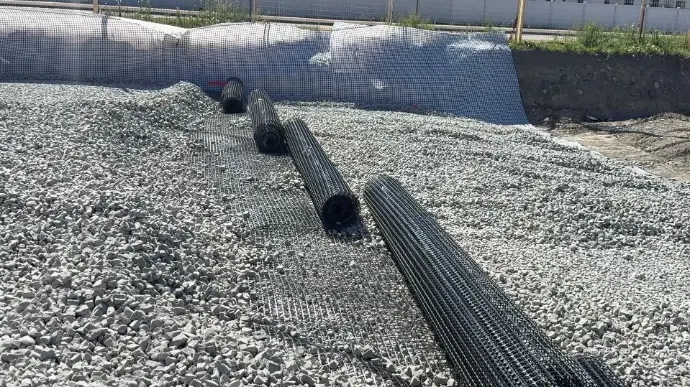
In the Kelowna design, compacted, geogrid-reinforced Enviro-Rock carries the footing loads and drains freely.[1] Bearing values come from the geotechnical engineer, and design guidance for foam glass aggregate projects less than 0.1% creep over 50 years under sustained stress up to about 96 kPa (2,000 psf).[3]
03
Fill and insulation in one layer
Enviro-Rock insulates while it serves as lightweight fill beneath slabs and around foundations.[4] Its dry test value is R-2.4 per inch[5]; moisture in service raises the conductivity of foam glass aggregate[6], so the energy designer sets the design value, and the authority having jurisdiction decides what it accepts for a loose fill.
04
Light fill over structure
Enviro-Rock is used in green roof build-ups, beneath pavers and pedestal systems and as lightweight fill over structural roof slabs.[7] It weighs 200 kg/m³ (12.5 lb/ft³) loose.[5]
05
Less pressure on below-grade walls
FHWA states that the low weight and high friction angle of foam glass aggregate can reduce vertical and lateral forces by more than one-half.[8] Enviro-Rock lists parkades among the places where its weight and drainage reduce settlement and earth pressure.[5]
06
Does not burn
Made from recycled glass, Enviro-Rock does not burn.[9] No fire test to a named standard has been published for it.
Applications
Used most in commercial buildings
Application
Soft ground embankments
Enviro-Rock foam glass aggregate fill for road embankments, grade raises and widenings over soft or compressible ground, accepted on BC's Recognized Products List.
Application
Retaining wall backfill
Free-draining foam glass aggregate backfill for MSE, cast-in-place and segmental retaining walls, where a lighter fill means less lateral earth pressure on the wall.
Application
Load-compensating foundations
Sub-excavate heavy soil under a building and rebuild with light Enviro-Rock fill, so the clay below carries less net load and settles less, as on a six-storey Kelowna project.
Application
Under-slab insulation
One layer of foam glass aggregate under a slab on grade that insulates, drains, breaks capillary rise and gives soil gas a path to a radon system.
Application
Green roof and plaza fill
Lightweight, free-draining foam glass aggregate for green roof build-ups, deep fill over roof slabs and the base under pavers and pedestals on plazas and terraces.
Questions
Common questions
How does load-compensating fill reduce settlement?
It replaces heavy soil with a much lighter fill, so the ground below carries less added load. In Kelowna, the design sub-excavates 1.8 m and rebuilds with 1.2 m of foam glass aggregate and mineral aggregate above, for expected settlement under 25 mm over 50 years.[1]
Does Enviro-Rock help meet energy code slab insulation requirements?
It adds thermal resistance under the slab[4], but Enviro-Rock has not published a code evaluation for it. Moisture in service raises the conductivity of foam glass aggregate[6], so the energy designer sets the design value, and the authority having jurisdiction decides what it accepts for a loose fill.
What is its compressive resistance?
In confined testing by modified EN 1097-11, Enviro-Rock reaches 0.56 MPa at 10% deformation, 1.01 MPa (147 psi) at 20% and 1.67 MPa at 30%.[5][10] These are index values for comparing aggregates, not allowable bearing pressures; the geotechnical engineer sets bearing values for the project.
Does it absorb water under a slab?
Water absorption is 7.2% uncompacted.[5] Closed cells inside each particle limit water penetration, while the spaces between particles drain freely.[11]
Sources
- [1] Case study: 6-storey building, Kelowna, Enviro-Corp Recycling
- [2] Enviro-Rock building construction brochure (metric), Enviro-Corp Recycling
- [3] Applications for Foamed Glass Lightweight Aggregate, final report, Illinois Tollway Research Program, Washington State University et al., 2025
- [4] Enviro-Rock benefits: thermal insulation, Enviro-Corp Recycling
- [5] Enviro-Rock civil infrastructure brochure (metric), specification table, Enviro-Corp Recycling
- [6] Field test comparing frost insulation materials in road construction, SINTEF and Norwegian Public Roads Administration
- [7] Enviro-Rock applications: green roofs and terraces, Enviro-Corp Recycling
- [8] Alternative Backfills for Highway Applications: State of the Practice (FHWA-HRT-23-110), Federal Highway Administration, 2024
- [9] Enviro-Rock cellular foam glass aggregate, Enviro-Corp Recycling
- [10] Enviro-Rock technical data, Enviro-Corp Recycling
- [11] Enviro-Rock benefits: closed-cell structure, Enviro-Corp Recycling
- [12] Case study: Jim Lorimer Park playground, Burnaby, Enviro-Corp Recycling
- [13] Enviro-Rock delivery trailer overview, Enviro-Corp Recycling
- [14] Delivering Enviro-Rock to downtown Vancouver from the Fraser Valley stockpile (video), Enviro-Corp Recycling
Get a price and a delivery window.
Tell us the application, the volume and where it is going. A real person replies with pricing and a delivery window.