Ministries, DOTs, design-builders and railways
Lightweight fill for highways, bridges and rail
Enviro-Rock is an accepted lightweight fill product on the BC Ministry of Transportation and Transit Recognized Products List.[1] It weighs about 200 kg/m³ (12.5 lb/ft³) loose, against 1,500 to 2,400 kg/m³ for mineral soils and aggregates.[2][3]
Challenges
Common site problems
01
Heavy fill on soft ground
Mineral soils and aggregates weigh about 1,500 to 2,400 kg/m³ (95 to 150 lb/ft³).[3] On soft or compressible ground, that weight drives settlement under new embankments, road widenings and approach fills.
02
Earth pressure on structures
Heavy backfill pushes on abutments, wing walls and retaining walls, and each structure has to be sized to resist it.
03
Submittals for a newer material
Agencies ask for test data, an installation plan and quality control records before a newer fill goes into a contract, as Maine DOT's project provision for foam glass aggregate does.[4]
Where Enviro-Rock fits
How Enviro-Rock helps
01
Accepted in BC
Enviro-Rock is listed as accepted under Lightweight Fill Material (product 1414). Accepted products may be used on Ministry projects as long as they meet the requirements of the Standard Specifications and/or the Work.[1] Alberta lists it as a Potential Product and has no experience with it yet.[5][6]
02
Less load on soft ground
Enviro-Rock weighs 200 kg/m³ (12.5 lb/ft³) loose and 240 kg/m³ (15.0 lb/ft³) at 20% compaction.[2] It is used for road embankments, grade raises, road widening and deep fills.[7]
03
Lower forces on abutments and walls
FHWA states that the low weight and high friction angle of foam glass aggregate can reduce vertical and lateral forces by more than one-half.[3] Enviro-Rock's friction angle is 39° at 65 kPa, and project values are confirmed by the geotechnical engineer.[2][8]
04
Fill below the track
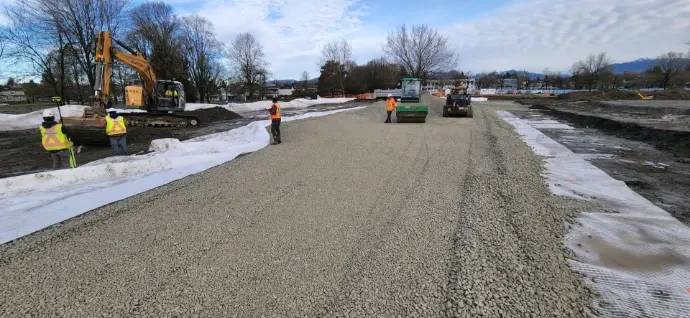
Enviro-Rock can go below conventional ballast and granular track layers as a lightweight fill zone, with geotextile separation as the design requires, including in rail yards, constrained corridors and track approaches near structures.[9]
Applications
Used most in transportation
Application
Soft ground embankments
Enviro-Rock foam glass aggregate fill for road embankments, grade raises and widenings over soft or compressible ground, accepted on BC's Recognized Products List.
Application
Retaining wall backfill
Free-draining foam glass aggregate backfill for MSE, cast-in-place and segmental retaining walls, where a lighter fill means less lateral earth pressure on the wall.
Application
Bridge approach fill
Lightweight, free-draining fill for bridge approach embankments and the backfill behind abutments and wing walls, to cut approach settlement and earth pressure on the structure.
Application
Trench backfill
Lightweight, insulating trench backfill for utility lines, pipeline corridors and manholes, to cut the load on buried pipes and help protect lines from frost.
Application
Railbed fill
Lightweight, free-draining subgrade fill below ballast for rail embankments on soft ground, track approaches near bridges, rail yards and constrained urban corridors.
Application
Frost protection
An insulating, non-frost-susceptible foam glass aggregate layer that reduces frost penetration into susceptible subgrades under roads, pavements and foundations in cold regions.
Questions
Common questions
Is Enviro-Rock on the BC Recognized Products List?
Yes. It is listed as an accepted product under Lightweight Fill Material in the BC Ministry of Transportation and Transit Recognized Products List, October 1, 2026 edition, as product 1414.[1]
Is Enviro-Rock approved by US state DOTs?
No. Enviro-Rock has no approval in Washington, Oregon, California or Alaska, so acceptance there rests with the project owner and the engineer of record. New York and Indiana have published specifications for foam glass aggregate fill, and Maine DOT has used a project special provision; they show what a state agency checks.[13][14][4]
Does foam glass aggregate float?
Yes, it is buoyant, so specifications place it above the water table or hold it down with cover material.[15] Maine DOT does not allow the fill to be submerged until it is ballasted.[4] At Jim Lorimer Park in Burnaby, where the site floods seasonally, the design anchored the fill against uplift.[16]
Will compaction crush the particles?
Heavy or vibratory compaction can, so the method is controlled. Enviro-Rock goes down in 300 to 600 mm loose lifts under a static roller with no vibration, or 150 to 300 mm under a plate compactor with more passes rather than more vibration, and is compacted 10 to 20%; jumping jacks are not used.[17][18]
What test reports can you provide for a submittal?
Reports are available on request for bulk density, water absorption, gradation, CBR, thermal resistivity, freeze-thaw and confined compressibility.[19]
Why does delivery distance matter?
Illinois Tollway research found that shipping distance significantly affects the cost of foam glass aggregate: in its example, an 800-mile haul added about $34 to an in-place cubic yard costing $169.[15] Enviro-Rock is delivered from its BC facilities, including a stockpile in the Fraser Valley[20], with pickup from Quesnel by appointment.[21]
Sources
- [1] Recognized Products List, Lightweight Fill Material (October 1, 2026), BC Ministry of Transportation and Transit
- [2] Enviro-Rock civil infrastructure brochure (metric), specification table, Enviro-Corp Recycling
- [3] Alternative Backfills for Highway Applications: State of the Practice (FHWA-HRT-23-110), Federal Highway Administration, 2024
- [4] Special Provision Section 203, Ultra-Lightweight Foamed Glass Aggregate, Maine DOT, 2025
- [5] Product evaluation: Enviro-Rock (8165-5-7), Alberta Transportation and Economic Corridors
- [6] Products List: Lightweight Fill (March 18, 2026), Alberta Transportation and Economic Corridors
- [7] Enviro-Rock applications: roadways and embankments, Enviro-Corp Recycling
- [8] Enviro-Rock benefits: angle of friction, Enviro-Corp Recycling
- [9] Enviro-Rock applications: railways and railbeds, Enviro-Corp Recycling
- [10] Enviro-Rock benefits: drainage and permeability, Enviro-Corp Recycling
- [11] Guidelines for Using Lightweight Fills in Transportation Infrastructure Applications, Texas DOT and University of Texas at Austin, 2025
- [12] Enviro-Rock delivery trailer overview, Enviro-Corp Recycling
- [13] Item 203.03200017, Lightweight Foamed Glass Aggregate Fill, New York State DOT, 2023
- [14] 904-M-076 Lightweight Aggregate, Indiana DOT, 2025
- [15] Applications for Foamed Glass Lightweight Aggregate, final report, Illinois Tollway Research Program, Washington State University et al., 2025
- [16] Case study: Jim Lorimer Park playground, Burnaby, Enviro-Corp Recycling
- [17] Enviro-Rock installation guide, Enviro-Corp Recycling
- [18] Enviro-Rock compaction equipment sheet, Enviro-Corp Recycling
- [19] Enviro-Rock technical data, Enviro-Corp Recycling
- [20] Delivering Enviro-Rock to downtown Vancouver from the Fraser Valley stockpile (video), Enviro-Corp Recycling
- [21] Frequently asked questions, Enviro-Corp Recycling
Get a price and a delivery window.
Tell us the application, the volume and where it is going. A real person replies with pricing and a delivery window.